Political Science vs International Relations Group 1 CSS
It is the most fiercely debated topic on every CSS forum in the country. It tears study groups apart. It causes candidates weeks of sleepless nights before the online registration deadline.
You must select one 200-mark subject from Group 1. The battle unequivocally zeroes in on the two absolute heavyweights of the syllabus. The choice is always Political Science vs IR CSS.
Choosing the wrong subject here is catastrophic. If you select a subject that clashes with your natural analytical style you will struggle to score even a 90 out of 200 effectively destroying any chance of a top-tier allocation like PAS or PSP.
Should you opt for the static predictable nature of Political Science or the dynamic globally relevant chaos of International Relations? Let us definitively break down the syllabus scoring trends and effort-to-reward ratios so you can make the smartest decision for your exact profile.
1. The Nature of the Beast Understanding the Syllabuses
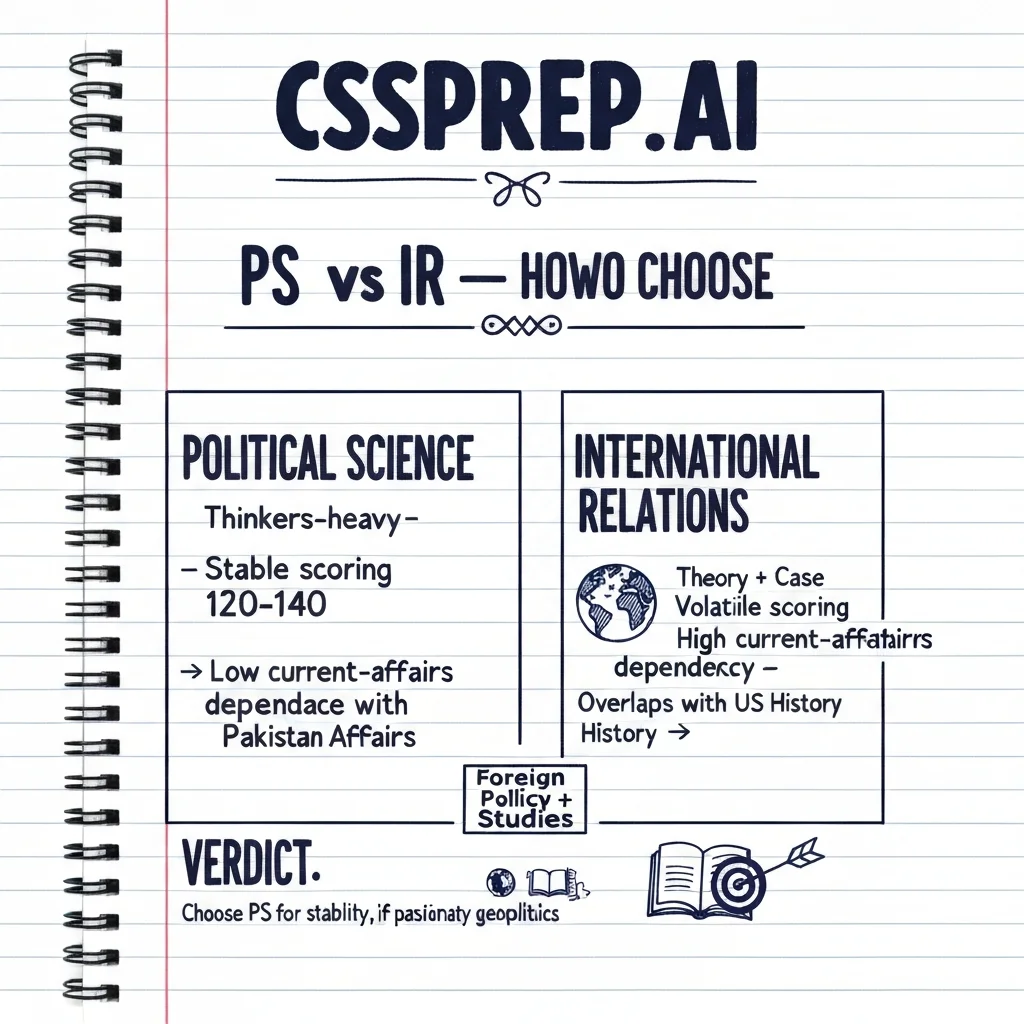
The fundamental difference in the Political Science vs IR CSS debate lies in how the subjects are intrinsically designed.
Political Science The Master of the Static
Political Science is primarily a study of institutions philosophers and historical statecraft.
- Paper 1 is deeply theoretical. You must study Western political thinkers like Plato Machiavelli and Hobbes alongside Muslim thinkers like Al-Farabi and Iqbal. You will dissect the concepts of sovereignty democracy and fascism.
- Paper 2 evaluates comparative constitutions. You will memorize and compare the exact constitutional frameworks of the USA UK France India and Pakistan.
- The VerdictThe syllabus is massive. It requires immense rote memorization of constitutional articles and philosophical timelines.However it never changes. Plato's philosophy will be exactly the same in 2027 as it was in 1990.
International Relations The Master of the Dynamic
International Relations is the study of how sovereign entities interact right now on the global stage.
- Paper 1 covers the grand theories like Realism Liberalism Constructivism and Marxism along with concepts like National Power Balance of Power and International Law.
- Paper 2 is essentially a giant Current Affairs paper focusing on the Cold War foreign policies of major powers global institutions like the UN and modern geopolitical conflicts spanning from the Middle East to the South China Sea.
- The Verdict The syllabus appears shorter than Political Science but it is infinite in reality. IR requires extremely high-level analytical skills. You cannot just memorize facts you must apply theory to a war that broke out yesterday.
2. The Great Overlap Which Subject Saves More Time
Both subjects offer significant overlap with your 600 marks of Compulsory subjects but in very different ways.
Political Science Overlap
- Overlaps heavily with Pakistan Affairs. The entire constitutional history of Pakistan leading up to the 1973 constitution is practically copy-pasted in Political Science Paper 2.
- It also provides robust structural arguments for CSS Essays specifically topics dealing with democracy governance and institutional failure.
International Relations Overlap
- IR essentially covers 80% of your Current Affairs syllabus. Preparing IR Paper 2 means you are simultaneously preparing for your 100-mark Current Affairs paper.
- It massively benefits you in the US History optional subject and provides excellent global dimensions for the English Essay.
3. Scoring Trends The Brutal Reality
This is where the debate usually ends for highly strategic candidates.
Historically the FPSC examiner has been incredibly ruthless with International Relations. Because every candidate reads the exact same newspaper articles thousands of IR answers look identical. The examiner demands elite-level theoretical application. If you describe the Russia-Ukraine war without explicitly applying the theoretical framework of Offensive Realism you will fail the question. Consequently the average IR score oscillates violently often hovering dangerously between 95 and 105 marks.
Political Science is statistically much safer. The examiner cannot penalize you if you correctly outline the US Constitution's system of Checks and Balances. It is an objective fact. Therefore candidates who successfully memorize the massive syllabus routinely secure 125 to 140 marks.
Winner for High Scores Political Science.
4. How to Make Your Final Choice
The decision in the Political Science vs IR CSS dilemma ultimately comes down to your personal academic stamina.
- Choose Political Science IF You have excellent memorization skills. You do not mind studying highly theoretical dense ancient philosophy. You want a safe high-scoring cushion for your aggregate. You struggle with keeping up with daily global news.
- Choose International Relations IF You naturally consume global news. You instinctively analyze foreign policy. You have a background in history or journalism. You hate rote memorization and prefer applying theories to living breathing modern conflicts.
5. Structuring the Chaos
Regardless of which giant you choose the sheer volume of information will overwhelm your notes.
If you choose IR you must map out complex theoretical models. If you choose Political Science you must compare four different constitutions without mixing up their specific legal articles. For both subjects linear notes fail. You must use our CSSPrep.AI Topic Explorer. You can visually link theoretical frameworks directly to the current events or historical constitutions they apply to. This highly visual study method allows you to revise 200 marks of syllabus in mere hours right before exam day.
Furthermore both subjects demand a highly academic objective tone. Use our CSSPrep.AI Essay Evaluator to test your answers. The AI will loudly flag if your IR analysis sounds like an emotional newspaper column rather than an elite bureaucratic briefing.
Useful Resources
- FPSC Official Website Download both syllabuses from the FPSC website immediately. Put them side-by-side and physically highlight which topics you already possess a baseline knowledge of.
- Foreign Affairs If you choose IR reading Foreign Affairs magazine is absolutely mandatory to understand how top-tier global analysts apply theoretical frameworks to modern issues.
Do not decide based on what your friends are doing. Analyze the syllabuses evaluate your own retention style and lock in your subject with absolute confidence.