Decoding the CSS Pakistan Affairs Syllabus for Maximum Marks
Pakistan Affairs perfectly embodies the duality of the CSS exams. On one hand it feels like the easiest subject on the roster. Every candidate has been reading about the 1857 War of Independence the Khilafat Movement and the two-nation theory since the 5th grade.
On the other hand it is precisely this familiarity that causes thousands of students to fail the paper. Candidates write simplistic Middle-School level historical narratives totally ignoring the fact that the CSS Pakistan Affairs syllabus demands a high-level master's degree analytical critique of historical and modern events.
To score maximum marks in Pakistan Affairs you must stop being a storyteller and start becoming a political scientist. Let us decode the syllabus structure and understand exactly where the examiner allocates the highest marks.
1. The Two Halves of the Syllabus
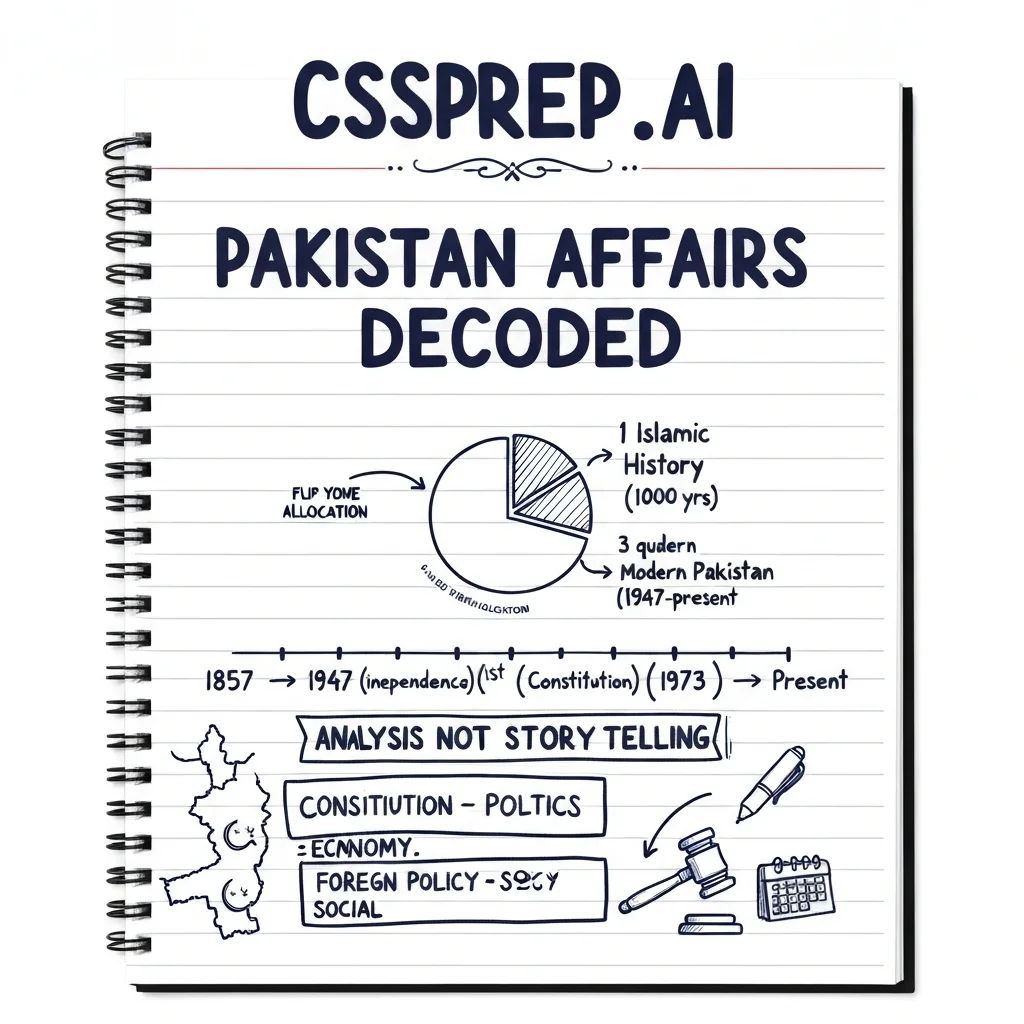
The FPSC explicitly divides the 100-mark CSS Pakistan Affairs syllabus into two distinct chronological phases but candidates usually focus horribly on the wrong one.
Part I Pre-Partition The Ideology & History
This section covers everything from the advent of Islam in the subcontinent through the fall of the Mughal Empire Aligarh Movement to the ultimate creation of Pakistan in 1947.
- The Trap Candidates love this section because it is a rigid story. They spend 4 months mastering every single date of the Pakistan Movement.
- The RealityThe examiner usually only asksONE subjective question worth 20 marks from this entire 1000-year historical block. Do not waste 60% of your study time on the pre-partition era. It yields an incredibly low return on investment.
Part II Post-Partition The Mechanics of the State
This section deals with the brutal reality of running the newly formed state. It covers the constitutional crises the military martial laws the economic challenges water disputes proxy wars and modern geopolitical maneuvering.
- The RealityThe examiner will extract at leastTHREE subjective questions worth 60 marks from this section. This is where the paper is won or lost. You must master the post-partition political era.
2. Converting History into Analysis
If the question is Discuss the role of the Aligarh Movement in the awakening of Muslims.
- A Failing Answer Storytelling The candidate will write five pages detailing where Sir Syed was born what schools he opened what books he wrote and conclude with "Sir Syed helped Muslims."
- A Maximum Marks Answer Analytical The candidate will briefly outline the schools Sir Syed opened but will dedicate 70% of the answer to analyzing why those schools were revolutionary. They will discuss how the Aligarh Movement shifted Muslims from emotional romanticism to scientific rationalism how it acted as a political shield against British retaliation post 1857 and how it laid the direct institutional framework for the Muslim League.
The examiner knows what happened. You must tell them why it mattered.
3. Mastering the 1947 to 1973 Constitutional Era
The single most important block of the CSS Pakistan Affairs syllabus is the constitutional timeline between 1947 and 1973. If you do not understand this era flawlessly your Pakistan Affairs paper will collapse.
You must be able to trace the political instability.
- Why did it take 9 years just to draft the 1956 Constitution while India drafted theirs in 3 years?
- How did the lack of provincial autonomy in the Objective Resolution directly feed the grievances that led to the tragic separation of East Pakistan in 1971?
- How does the 18th Amendment to the 1973 Constitution solve or complicate the political structure today?
Do not just memorize the dates of martial laws. Understand the socio-economic domino effect each law caused.
4. The Critical Component Modern Pakistan
The final section of the syllabus overlaps directly with Current Affairs. You will face questions on Pakistan's modern economy its agricultural and water crisis and its geopolitical standing specifically CPEC relations with India and Afghanistan.
- Data is King To score high here you cannot use vague terms like "Pakistan is facing an energy crisis." You must use hard data. Write "Circular debt in the energy sector has crossed 2.3 trillion rupees suffocating large scale manufacturing."
- Always back up your claims with reports from the World Bank the IMF or the Pakistan Bureau of Statistics.
5. Visualizing the Chaos of Pakistan Affairs
The history of Pakistan is chaotic. There are dozens of political parties military interventions and constitutional amendments. Reading them linearly from a textbook often results in a jumbled mess in the exam hall.
You need to establish a strict mental timeline. Our CSSPrep.AI Topic Explorer is the ultimate tool for this subject. You can create a massive visual tree starting from 1947 branching off into the different prime ministerial tenures the constitutional acts passed during those tenures and the economic policies implemented. When you have a complex sequence like the events leading to the 1971 war mapped out visually reproducing it structurally in the exam takes mere seconds.
Additionally to ensure your analytical paragraphs aren't reverting into middle-school storytelling run your practice answers through our CSSPrep.AI Essay Evaluator. It will ruthlessly point out if your arguments lack thesis driven depth.
Useful Resources
- PIDE The Pakistan Institute of Development Economics PIDE produces incredible highly analytical short papers on structural economic issues in Pakistan. Quote their research directly in your answers.
- The Friday Times For high-level critical perspectives on domestic politics and historical events which differ from generic guidebooks.
Mastering the CSS Pakistan Affairs syllabus is about elevating your perspective. Treat the subject with the academic rigor it demands. Focus heavily on the post-partition constitutional crises use hard data for modern issues and always show the examiner the Why behind the What.