1. Introduction to the CSS 2027 Journey
The Central Superior Services(CSS) examination, conducted annually by the Federal Public Service Commission(FPSC) of Pakistan, remains one of the most prestigious and intensely competitive milestones an aspiring civil servant can pursue. While the 2026 exams have concluded, the window for CSS 2027 preparation is now wide open. Success in CSS is rarely a byproduct of serendipity or last - minute cramming; rather, it is the result of a meticulously structured, year - long intellectual marathon.
Every year, tens of thousands of candidates sit for the exam, but the pass rate typically hovers in the low single digits(often between 1.5% to 3%).Why is the attrition rate so severe? The vast majority of candidates fail not because they lack raw intelligence, but because they fundamentally misunderstand the nature of the examination. The FPSC is not looking for human encyclopedias who can regurgitate memorized facts; they are actively seeking analytical thinkers who can synthesize complex information, articulate coherent arguments, and demonstrate a profound understanding of Pakistan's domestic and international operational environment.
For the CSS 2027 cycle, traditional coaching academy models—which traditionally emphasize rote learning and generalized notes—are increasingly proving inadequate against the dynamic, analytical testing standards of the modern FPSC.Today's successful candidates are agile self-learners who leverage targeted reading, aggressive practice, and increasingly, AI-driven feedback tools. This 2,000-word comprehensive guide is designed to deconstruct the entirety of the CSS preparation lifecycle, equipping you with the strategic framework required to transition from merely participating in the 2027 exams to actively dominating them.
2. Deconstructing the FPSC CSS Syllabus
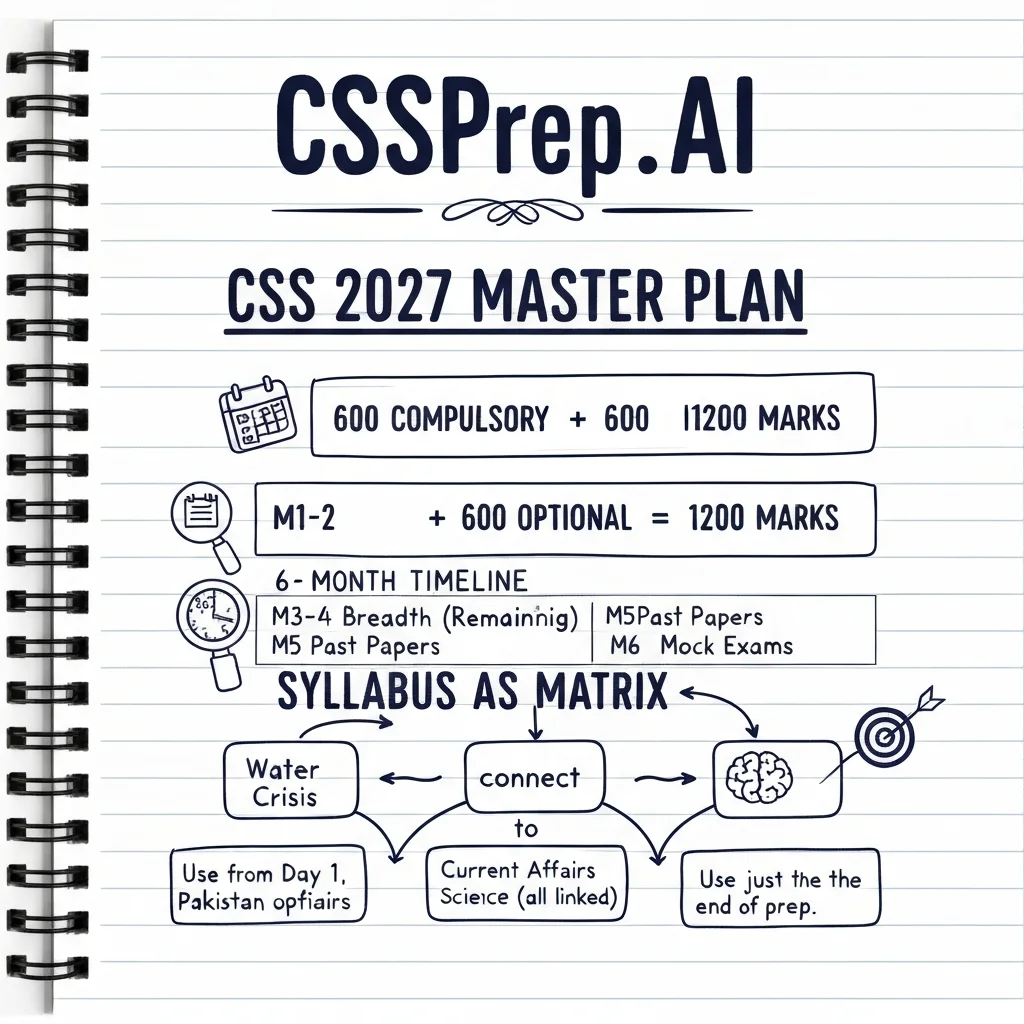
The CSS syllabus is an intimidating 1, 200 - mark behemoth, evenly bifurcated into 600 marks of Compulsory subjects and 600 marks of Optional subjects. To conquer it, you must first understand its architecture.
The Compulsory Core(600 Marks)
The compulsory subjects are the great equalizer. Every candidate, regardless of their academic background—be it medicine, engineering, or literature—must navigate these six papers:
- English Essay (100 Marks): The ultimate gatekeeper. This paper demands original thought, sophisticated vocabulary, and impeccable grammatical structure.
- English (Precis and Composition) (100 Marks): Tests your ability to distill complex texts into their essence and your command over syntax and vocabulary.
- General Science and Ability (100 Marks): A blend of everyday science, environmental concepts, and fundamental quantitative / logical reasoning.
- Current Affairs (100 Marks): Requires a deep, multi-dimensional analysis of domestic, regional, and global socioeconomic and political issues over the last 1-2 years.
- Pakistan Affairs (100 Marks): Demands historical context applied to contemporary challenges (e.g., how the post-18th Amendment landscape affects current governance).
- Islamic Studies / Comparative Religion (100 Marks): Tests knowledge of Islamic jurisprudence, history, and the application of Islamic principles to modern societal frameworks.
The Preparation Philosophy
The most common error candidates make is treating the syllabus linearly—reading it from cover to cover like a textbook. Instead, you must treat the syllabus as a matrix of interconnected concepts. For example, the water crisis in Pakistan is profoundly relevant to Current Affairs(international treaties), Pakistan Affairs(inter - provincial harmony), and General Science(climate change).When you study a topic, map it across multiple subjects immediately. This integrated approach not only saves hundreds of hours but ensures the analytical depth that examiners actively reward.
3. Choosing High - Scoring Optional Subjects for 2027
Selecting your 600 marks of optional subjects is arguably the most critical strategic decision of your CSS journey.A poor selection can cap your aggregate score and prevent allocation, even if you clear all compulsory papers.
The Myth of the "Scoring Trend"
Walk into any CSS academy, and you will hear whispers of "scoring trends"—the idea that FPSC systematically targets or favors certain subjects in specific years. While statistical variations exist(often due to the quality of the examiner or a massive influx of underprepared candidates taking popular subjects), chasing trends is a losing strategy. The FPSC punishes surface - level knowledge. If you choose a subject solely because it "scored well last year" but have no foundational aptitude for it, you will likely score poorly.
The Three - Tier Selection Strategy
To optimize your optional selection for the 2027 exam, evaluate subjects against three criteria:
- Academic Alignment: Start with what you know. If you have a degree in Economics, Computer Science, or Accountancy, leverage it. These technical subjects have highly objective marking criteria and can yield scores of 75+ if mastered, providing a massive aggregate boost.
- Syllabus Overlap: Look for subjects that subsidize your compulsory preparation. For instance:
- International Relations (IR) or Political Science overlap heavily with Current Affairs and Pakistan Affairs.
- Public Administration or Governance & Public Policies provide an excellent theoretical framework that you can deploy in your English Essays regarding statecraft and reform.
- Syllabus Length and Constraints: Be realistic about the timeline. Subjects like US History or Gender Studies are popular precisely because their syllabi are relatively contained and can be prepared within a 4-to-6-week timeframe, whereas completing the expansive History of Indo-Pak requires a significantly larger time investment.
Recommended Grouping for Non-Specialists: For candidates without a specialized quantitative degree, a highly synergistic grouping often looks like this: Political Science (200), US History (100), Public Administration (100), Gender Studies (100), and Criminology or Sociology (100). This combination provides immense thematic overlap, reducing your total reading burden by at least 20%.
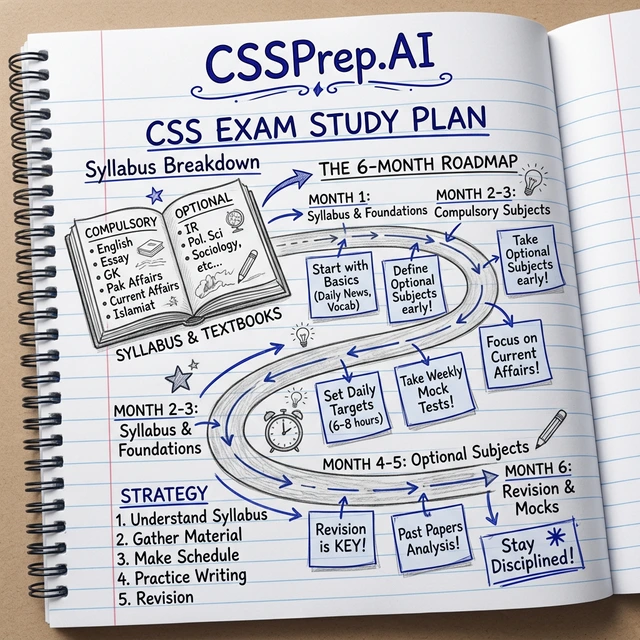
4. Building a 6 - Month CSS Study Plan
With your subjects locked in, execution is everything.A 12 - month timeline is luxurious, but an aggressive, highly disciplined 6 - month plan is entirely viable for CSS 2027 if executed correctly. Here is how to structure it.
Months 1 - 2: Foundation and Conceptual Overlap(The "Deep Reading" Phase)
Do not start writing full essays yet. Your initial priority is building intellectual capital. Focus entirely on your heaviest overlapping subjects: Political Science / IR, Current Affairs, and Pakistan Affairs. Read foundational texts, establish your core notes, and critically, start reading * Dawn * daily.
- Daily Routine: 4 hours of subject study, 1.5 hours of Dawn reading and vocabulary extraction, 30 minutes of English grammar / Precis practice.
Months 3 - 4: Breadth and First Iteration Revision
Transition into your remaining optional subjects(US History, Gender Studies, etc.) while concurrently beginning to draft outlines for the English Essay. The knowledge you built in Months 1 - 2 will now serve as raw material for these essays.
- Daily Routine: 3 hours of new optional subjects, 2 hours of revising Months 1-2 material, 1 hour of active Essay / Precis outlining.
Month 5: The "Output" Phase(Past Papers & Synthesis)
Stop acquiring new books. Month 5 is strictly about applied output. Analyze the last 5 - 7 years of FPSC past papers for every subject to identify the examiner's favorite thematic clusters. Start timing your answers. A perfect answer that takes 55 minutes to write is a failed answer in the CSS exam, where you have roughly 35 minutes per question.
- Target: Write one full-length essay every weekend. Draft 2-3 timed, 20-mark answers daily.
Month 6: Mock Exams and Micro - Adjustments
This is where aggregate scores are won. Replicate exam conditions. Sit at a desk, remove all electronics, and write for 3 continuous hours. You will discover physical fatigue, time mismanagement, and memory lapses that you never encountered during casual study. Identify these weaknesses and utilize micro - revisions to plug the remaining factual gaps.
5. The Importance of Past Papers and Examiner Reports
FPSC Examiner Reports are the most valuable, underutilized resource in CSS preparation. Every year, the FPSC publishes aggregated feedback from the examiners who actually graded the papers. Reading these reports is akin to receiving the answer key.
What the Examiners Consistently Complain About:
- Rote Memorization: Examiners universally lament candidates who reproduce pre-packaged academy answers regardless of the specific nuance of the question asked.
- Structural Collapse: Answers that begin well but devolve into chaotic, un-paragraphed streams of consciousness by page four.
- Lack of Analytical Synthesis: Candidates who write 10 pages defining a problem, but allocate only one paragraph to proposing viable, localized solutions.
Reversing the Past Papers
Do not use past papers merely to test yourself at the end of your preparation; use them to * guide * your preparation from day one. When you begin a new topic(e.g., "The UN Security Council Reforms"), immediately look at how the FPSC has formulated questions on that topic in 2020, 2022, and 2024. Are they asking about the history of the UN, or are they asking about the structural veto disparities affecting the Global South? Tailor your note - making strictly to the angle the examiner favors.
6. Smart Preparation with CSSPREP.AI
Historically, the highest barrier to CSS success has been the feedback loop.A candidate in a remote district could read all the right books, but without an expert to evaluate their essays or structure their thoughts, they operated in a vacuum. In preparing for CSS 2027, Artificial Intelligence has permanently leveled this playing field.
CSSPREP.AI is designed to engineer that missing feedback loop using advanced AI models specifically calibrated for FPSC frameworks.
The Essay Evaluator
Rather than waiting two weeks for a tutor to return a marked essay with vague comments like "improve structure," you can paste your essay directly into ourEvaluator tool.Within seconds, the AI assesses your submission against core FPSC parameters: thesis clarity, PEEL paragraph structure(Point, Evidence, Explanation, Link), vocabulary deployment, and transitions. It highlights specific assertions that lack evidence and flags grammatical inconsistencies, allowing for rapid, daily iteration.
The Topic Explorer
The CSS syllabus tests networked knowledge. To excel, you must connect seemingly disparate nodes. Instead of linear outlines, use ourTopic Explorer to visually architecture your 20 - mark answers. Input a complex topic like "Socio-economic impacts of CPEC," and instantly generate a multi - tiered visualization connecting infrastructure debt, local employment dynamics, and geopolitical alignments—ensuring you never leave marks on the table by forgetting a crucial dimension.
The CSS 2027 exam requires unprecedented analytical rigor. By combining an optimized subject selection, a disciplined 6 - month study matrix, and the immediate, diagnostic feedback of CSSPREP.AI, you are no longer just preparing for the exam—you are engineering your success.