
The Marking Scheme Is a Blueprint — Are You Reading It?
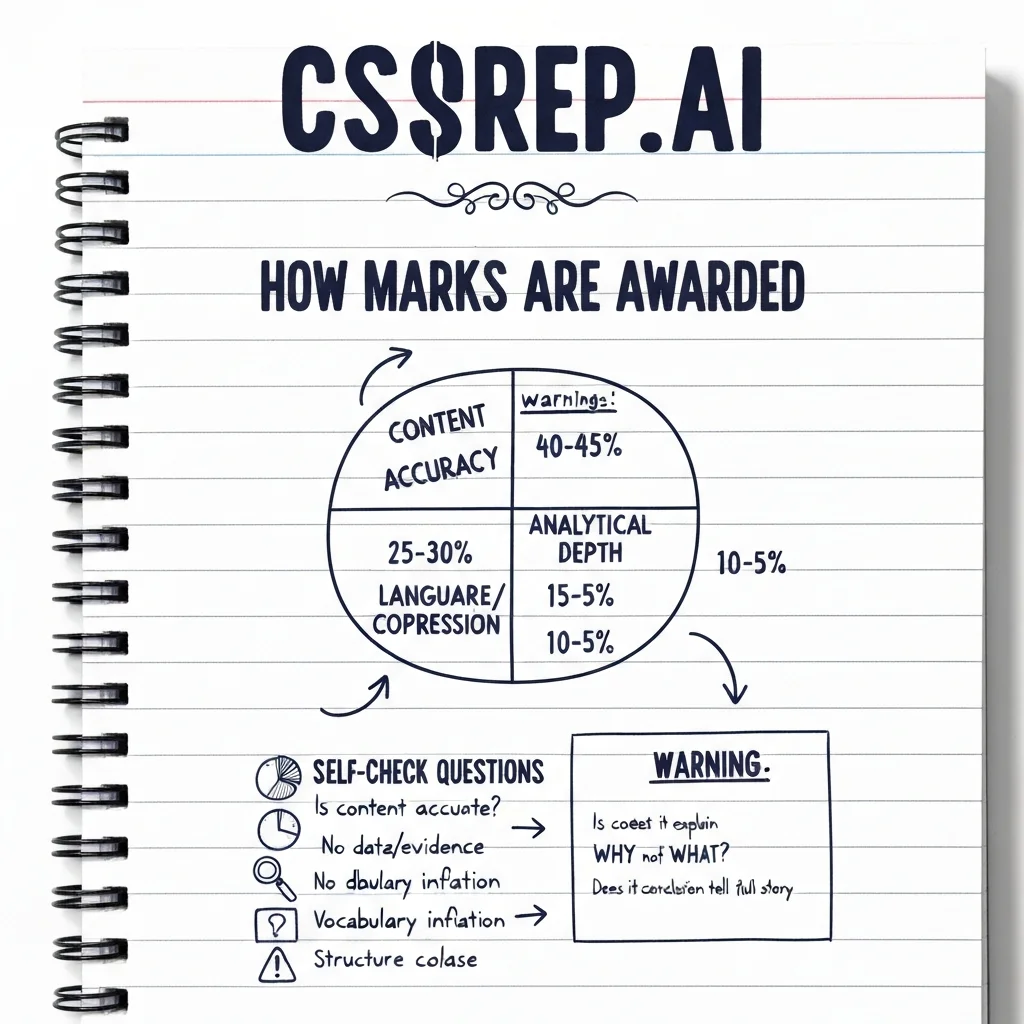
FPSC publishes general marking guidelines, and experienced CSS examiners follow a fairly consistent rubric across papers. Yet the majority of candidates prepare in the dark — memorizing content without understanding how that content is evaluated.
This is a fundamental strategic mistake.
If you know how marks are allocated, you can reverse-engineer your answers to maximize each component. This guide breaks down the CSS evaluation framework and tells you exactly what behaviors earn marks.
The Four Pillars of CSS Marking
Across most CSS papers — essay, current affairs, Pakistan affairs, and general knowledge — examiners evaluate answers on four dimensions:
1. Content Accuracy and Relevance (40–45% of marks)
This is the factual core of your answer. Examiners ask:
- Are the facts correct?
- Are they relevant to the question?
- Is the answer complete (no major omissions)?
What earns full marks here:
- Accurate dates, names, statistics, and events
- Coverage of all major sub-topics implied by the question
- No irrelevant padding that dilutes the answer
Common deductions:
- Factual errors (even one significant error can cost 2–4 marks)
- Answering a related but different question
- Leaving out a major aspect the question clearly demanded
2. Analytical Depth (25–30% of marks)
This is where most candidates lose marks and don't understand why. Content alone is not enough — you must analyze it.
Analysis means:
- Explaining causes and effects, not just describing events
- Evaluating competing perspectives
- Drawing inferences from evidence
- Identifying patterns, tensions, or contradictions
| Low-scoring answer | High-scoring answer |
|---|---|
| "CPEC has brought investment to Pakistan." | "CPEC's investment model creates a debt-service liability that could constrain fiscal policy for two decades, raising legitimate questions about whether the infrastructure gains justify the long-term financial exposure." |
The high-scoring version takes the same fact and does something with it.
3. Structure and Coherence (15–20% of marks)
Examiners mark faster than you think. A well-structured answer is easier to mark and earns higher coherence scores.
What structure marks reward:
- Clear introduction that frames the answer
- Logical sequencing of points
- Transitions between paragraphs
- A conclusion that synthesizes rather than repeats
Penalty zone:
- Stream-of-consciousness writing with no paragraph breaks
- Repeating the same point in different words
- Abrupt endings with no conclusion
4. Language and Expression (10–15% of marks)
Technical accuracy in language matters more at CSS level than candidates expect.
What earns these marks:
- Grammatically correct sentences
- Appropriate academic register
- Precise technical vocabulary used correctly
- Varied sentence structure
What loses these marks:
- Subject-verb disagreement
- Informal phrasing ("this is a big problem")
- Repeating the same vocabulary throughout
Paper-Specific Nuances
Essay Paper
The essay carries 100 marks as a single question. Structural weight is higher here — examiners specifically look for thesis-driven argumentation and logical flow. Content breadth matters less than analytical depth.
Rule of thumb: A 2000-word essay with a clear thesis and 5 well-supported arguments will outscore a 2500-word essay that covers more ground without a unifying argument.
Current Affairs
Short answers (15–20 marks each). The premium is on relevance and completeness. Cover all the key dimensions of the topic quickly.
Time allocation: 12–15 minutes per question maximum. If you write more, you're writing padding.
Pakistan Affairs / General Knowledge
More descriptive than analytical, but examiners still reward candidates who can explain significance, not just recite facts.
Key differentiator: A sentence connecting the historical event to its contemporary relevance earns marks most candidates miss.
The Marks Candidates Leave on the Table
After reviewing thousands of CSS scripts, patterns emerge in where marks are systematically lost:
1. The incomplete conclusion loss — Stopping the answer without a synthesizing conclusion costs 2–4 marks on most questions. It takes 3 minutes to write a conclusion. Write it.
2. The evidence assertion gap — Stating a claim without evidence. "Pakistan's agricultural sector is underdeveloped" earns fewer marks than "Pakistan's agricultural productivity averages 2.2 tonnes/hectare of wheat, compared to 3.5 in India and 5.5 in China — a gap attributable to fragmented landholdings, water inefficiency, and credit market failures."
3. The vocabulary inflation loss — Using complex words incorrectly. Examiners penalize misused technical vocabulary more harshly than simple vocabulary used correctly.
4. The structure collapse — Starting well but deteriorating into a list in the final third. Fatigue affects writing quality; candidates who maintain structure throughout outperform those who don't.
How to Self-Evaluate Before the Exam
Use this four-point checklist on every practice answer:
- Content: List the key facts / examples in this answer. Is anything factually incorrect? Is anything major missing?
- Analysis: Does this answer explain why and so what, or does it just describe what?
- Structure: Read only your intro and conclusion. Do they together communicate the full argument?
- Language: Circle every technical term. Did you use each one correctly?
If you cannot confidently say yes to all four, the answer needs revision.
Using AI to Simulate Examiner Feedback
One of the most effective ways to internalize the marking scheme is to get granular feedback on practice answers — not "this was good" but "you scored 8/12 on analysis because you described the policy without evaluating its tradeoffs."
This kind of feedback, which CSS examiners rarely have time to provide, is exactly what AI evaluation tools can replicate. The key is to use them consistently and treat the feedback seriously, not as validation but as a diagnostic.
The Strategic Takeaway
Understanding the marking scheme converts exam preparation from a content-memorization exercise into a performance-optimization exercise. You are not being tested on what you know — you are being tested on your ability to communicate what you know in a specific, evaluable format.
Master the format. The content follows.