A Step by Step CSS Preparation Study Plan for Beginners
Deciding to attempt the Central Superior Services (CSS) examination is a monumental choice. The prestige of becoming a CSP officer is unmatched. However when you actually look at the 1200 marks syllabus for the very first time the sheer volume of information can be entirely overwhelming.
Where do you even begin? Should you start with English essays or dive straight into International Relations? Should you read DAWN newspaper for 3 hours a day or focus on past papers?
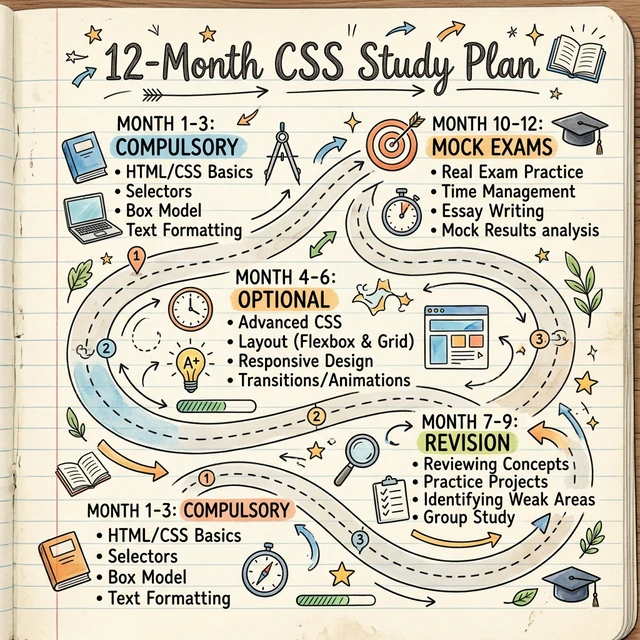
If you are just starting and feel profoundly lost this guide is exactly for you. We have crafted a comprehensive and proven CSS preparation for beginners study plan that systematically breaks down the entire 12-month prep journey into manageable and actionable phases.
By the end of this read you will have a clear customized roadmap to conquer the FPSC syllabus without losing your mind in the process.
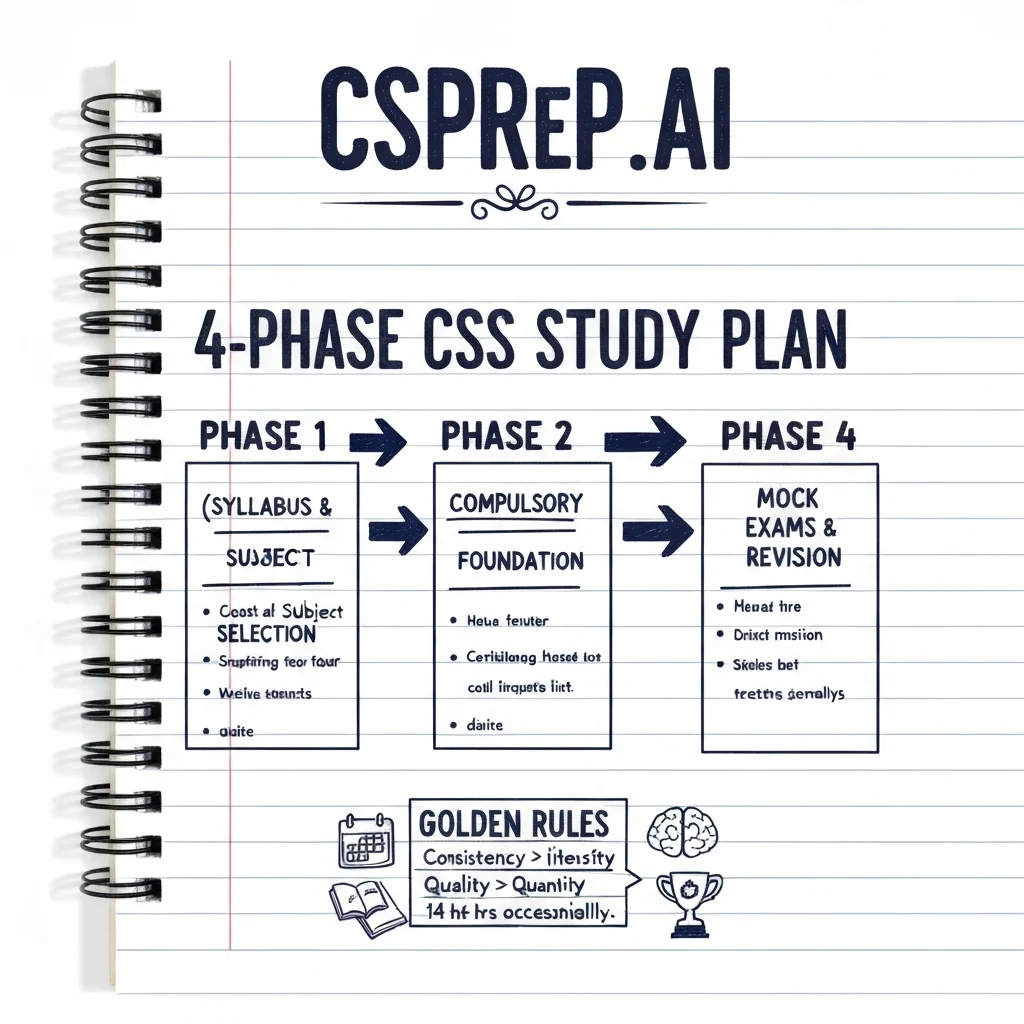
Phase 1 Syllabus Orientation and Subject Selection
The most common mistake beginners make is opening a book on Pakistan Affairs on Day 1 without understanding the playing field. CSS preparation for beginners must always start with orientation.
- Download the Official Syllabus Go to the official Federal Public Service Commission (FPSC) website and download the revised syllabus. Read through every single compulsory and optional subject.
- Finalize Your Optional Subjects Your optional subjects account for 600 out of the total 1200 written marks. You need to select subjects based on your academic background like if you have a BS in Computer Science take Computer Science. You should also consider syllabus overlap like how US History overlaps with IR and scoring trends where regional languages like Punjabi or Sindhi yield high scores.
- Analyze Past Papers Download the last 5 years of past papers for your selected subjects. Do not try to solve them. Just read them. Analyze how the FPSC frames questions. Are they asking for rote-memorized dates or critical analysis of events?
This foundational month prevents you from wasting hundreds of hours studying the wrong things.
Phase 2 Building the Foundation Compulsory Subjects
Once your subjects are locked in it is time to build the foundation. The 600 marks of compulsory subjects are where the vast majority of candidates fail. You must secure these first.
- English Essay and Precis English is not a subject you can memorize. It is a skill you must practice. Begin with the basics of grammar. Every single day read the editorial section of DAWN or The News. Note down 5 new vocabulary words and their usage. Furthermore practice writing one PEEL paragraph daily which stands for Point Evidence Explanation Link.
- Pakistan Affairs and Current Affairs These two subjects should be studied together as they continuously overlap. Focus on the core historical blocks from 1857 to present day and pair them with modern geopolitical events affecting Pakistan.
- Islamic Studies and General Science and Ability Dedicate a fixed slot for these. For GSA emphasize everyday science and basic mathematics like Algebra Geometry and Analytical Reasoning as it is highly scoring and entirely objective.
A Note on Managing Information Overload
You will read an immense amount of data during these four months. If you read a book and take linear notes you will forget 80% of it by the time exams arrive. To combat this we highly recommend trying out visual learning. Our CSSPrep.AI Topic Explorer allows you to convert complex historical timelines or essay outlines into highly visual interconnected nodes. It is a game-changer for long-term retention.
Phase 3 Mastering Optional Subjects
With a solid grip on the compulsory subjects shift your primary focus to your 600 marks of optional subjects.
- Tackle the Heavies First If you opted for a 200-mark subject like Political Science or International Relations attack them immediately. They require deep theoretical understanding.
- Tackle the Scorers Last Regional languages or highly objective subjects with shorter syllabuses like US History or Sociology can be kept for Months 8 and 9.
- The 60 40 Rule During this phase spend 60% of your time on your optional subjects but allocate 40% of your daily time to maintaining your compulsory subjects specifically English writing practice and daily Current Affairs updates.
Phase 4 Mock Exams Revision and Final Polish
The last three months are the crucible. This is where you transform from a prepared student into an exam-ready candidate.
- Stop Reading New Books Do not open a new textbook two months before the exam. You must consolidate what you already know. Rely strictly on your own notes.
- Solve Past Papers Now is the time to actively solve those past papers you reviewed in Month 1. Set a timer for 3 hours and simulate the exam environment. Writing a 2,500-word essay at home is vastly different from writing one under the immense pressure of a ticking clock.
- Get Your Work Evaluated Writing an essay is useless if nobody critiques it. If you cannot find a qualified mentor to grade your work utilize our CSSPrep.AI Essay Evaluator. It uses FPSC-calibrated AI to instantly point out fatal flaws in your thesis statements structural coherence and grammatical precision.
- Focus on the MCQs MCQs account for 20 marks in almost every paper. Scoring 15+ in MCQs can instantly bump your overall grade from a failure to a comfortable pass.
The Golden Rules for Beginners
Before you embark on this 12-month journey cement these golden rules into your mindset.
- Consistency over Intensity Studying 4 hours every single day for a year is infinitely more effective than studying 14 hours a day for two months and burning out.
- Quality over Quantity The examiner does not care if you read 10 books on one subject. They care if you can concisely articulate the core concepts from 2 good books.
- Take Breaks CSS prep is a marathon not a sprint. Take one day off every week to reset your mind.
Useful Resources to Kickstart Your Prep
- FPSC Official Website The only official source for syllabus revisions cut-off dates and past papers. Bookmark it immediately.
- Dawn News DAWN News Editorials are the absolute gold standard for developing your analytical tone and staying updated on current affairs.
- The Express Tribune The Express Tribune frequently features excellent socio-economic analysis that perfectly mirrors CSS essay topics.
A proper CSS preparation for beginners strategy removes the anxiety and replaces it with structured execution. Trust the process follow your schedule daily and remember why you started this journey in the first place. You can do this.