
The Problem With Linear Notes
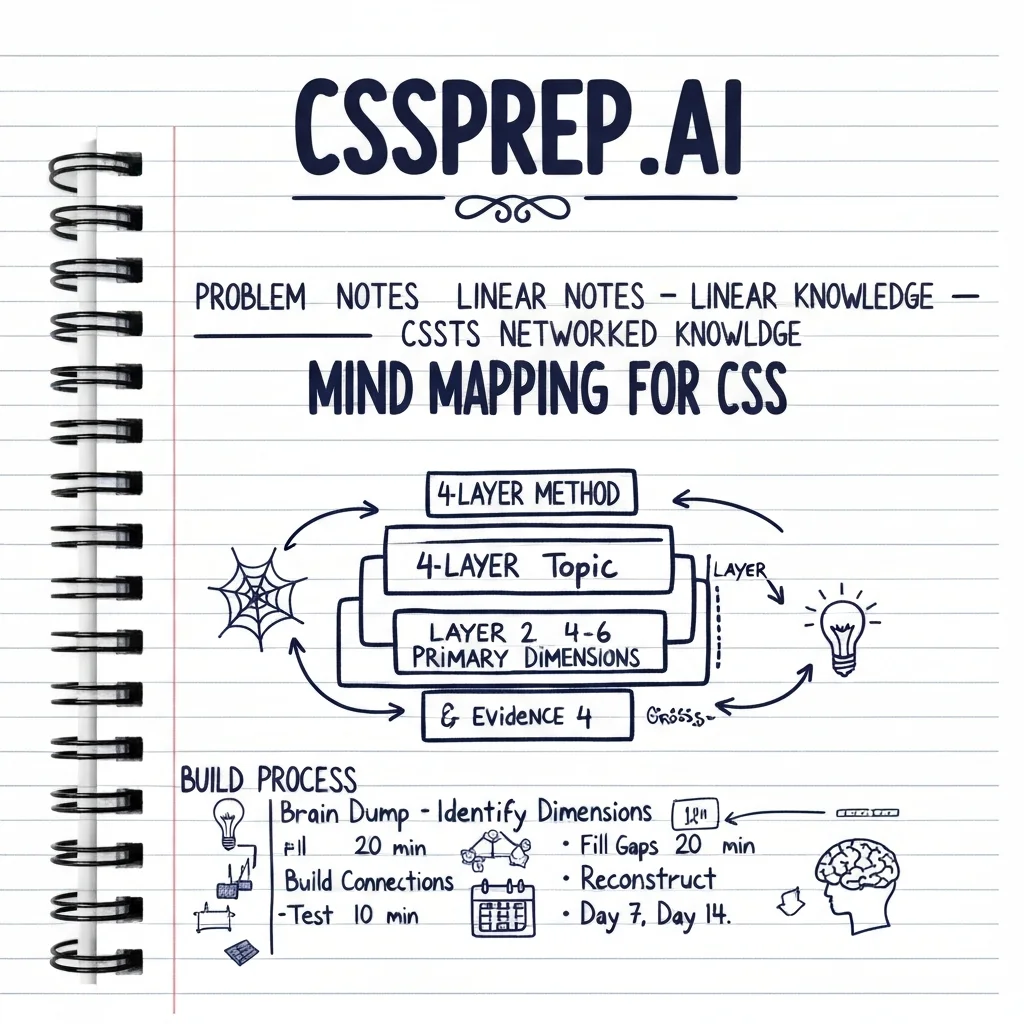
Most CSS candidates study the way they were taught in school: read a chapter, write linear notes, memorize those notes.
This approach has a fatal flaw for CSS: the exam does not test linear recall. It tests your ability to connect ideas across topics, apply concepts to novel situations, and analyze complex systems.
Linear notes build linear knowledge. CSS demands networked knowledge.
What Mind Maps Actually Do
A mind map is not a pretty diagram. It is a visual representation of how concepts relate to each other.
When you build a mind map for "Pakistan's Water Crisis," you are forced to make connections that a linear outline would bury:
- Water scarcity → agricultural productivity → food security → import bill → current account deficit
- Water scarcity → rural-urban migration → urbanization pressures → governance challenges
- Water scarcity → India-Pakistan relations → Indus Waters Treaty → diplomatic context
- Water scarcity → climate change vulnerability → international financing for adaptation
These connections are exactly what CSS essay questions test. "Discuss the socioeconomic implications of water scarcity in Pakistan" is not a question about water — it is a question about how water connects to everything else.
Linear notes cover water. Mind maps cover the connections.
The Four-Layer Mind Map Method
The most effective CSS mind maps use four layers of depth. Each layer builds analytical complexity.
Layer 1: The Core Topic
The center of your map. One to three words maximum.
Example: Pakistan Agriculture
Layer 2: Primary Dimensions
The major sub-topics or categories — 4–6 parallel branches.
- Crop Production
- Water Resources
- Land Tenure
- Market Access
- Policy Framework
- Climate Vulnerability
Layer 3: Key Concepts & Evidence
For each primary dimension, the specific facts, examples, and concepts you must know.
Under Water Resources:
- Indus basin system (Indus, Jhelum, Chenab, Ravi, Sutlej, Beas)
- Canal irrigation: 58 million acres irrigated, world's largest contiguous irrigation system
- Water productivity gap: 0.9 kg/m³ vs. 1.7 kg/m³ global average
- Treaty constraints: Indus Waters Treaty 1960 allocation mechanics
Layer 4: Analytical Connections
The cross-connections that transform information into analysis. This is the layer most candidates never build.
- Water productivity gap → technology adoption → credit access → rural banking policy
- Canal irrigation → soil salinization → agricultural decline in Sindh → rural poverty
- Indus Waters Treaty → India relations → climate change stress → future conflict risk
The fourth layer is what separates a 50-mark answer from a 70-mark answer.
Which Topics Benefit Most from Mind Mapping
Not all CSS content is equally suited to mind mapping. The highest-value topics to mind map are:
High complexity / high connectivity:
- Pakistan's political economy
- Constitutional framework (18th Amendment, federalism)
- China-Pakistan Economic Corridor
- Climate change and Pakistan
- Pakistan's foreign policy architecture
High data density:
- Economic indicators and sectors
- Administrative structure (federal/provincial)
- Historical timeline topics
Lower value for mind mapping:
- Pure memorization topics (dates, names, treaties)
- Simple causal chains with no branching
How to Build a CSS Mind Map (Step-by-Step)
-
Brain dump (10 minutes) — Without looking at notes, write everything you know about the topic. Unstructured. No judgment.
-
Identify primary dimensions (5 minutes) — Group your brain dump into 4–6 major categories. These become your Layer 2 branches.
-
Research gaps (20–30 minutes) — For each branch, identify what you don't know. Look up those gaps. Add Layer 3 details.
-
Build connections (15 minutes) — The crucial step. For each Layer 3 concept, ask: "What else does this connect to?" Draw the connections. These become your Layer 4.
-
Review and test (10 minutes) — Cover the map. Try to reconstruct it from memory. The reconstruction process is where learning happens.
The Spaced Repetition Integration
Mind maps are most powerful when combined with spaced repetition.
- Day 1: Build the mind map.
- Day 3: Reconstruct from memory, check against original.
- Day 7: Reconstruct again, add any new connections you have learned.
- Day 14: Final reconstruction. The map should now be internalized.
This protocol takes approximately 90 minutes total over two weeks. It builds durable, networked knowledge that holds under exam pressure.
Compare this to re-reading linear notes four times over the same period — which produces fragile, surface-level recall.
Digital vs. Paper Mind Maps
Both have merits. For CSS preparation specifically:
Paper (recommended for initial construction):
- Forces active engagement — you can't just drag and drop
- Spatial memory enhances recall
- No distraction
Digital (recommended for storage and review):
- Searchable and shareable
- Easier to update as you learn more
- Can generate connections algorithmically (AI tools)
The optimal workflow: build on paper, transfer to digital for storage, review digital versions.
The Collaborative Study Advantage
One underused technique: compare mind maps with a study partner.
Build independent mind maps for the same topic, then compare. Your partner will have connections and examples you missed. Their map will have gaps yours fills. The discussion that follows — "why did you connect X to Y?" — is high-quality retrieval practice.
If you do not have a study partner, use AI-generated mind maps as a comparison tool. Generate a map on a topic you have already studied independently, then identify what the AI included that you missed and vice versa.
CSS Exam Day Application
Mind maps are not just a study tool — they are an exam planning tool.
When you receive an essay question, you have 20 minutes before you should start writing. Use that time to rapidly sketch a mini mind map:
- Core topic in the center
- 5–6 argument nodes as branches
- 1–2 evidence points per node
- Cross-connections that become your analytical insights
This 20-minute investment produces a dramatically better essay than starting to write immediately. The map serves as your outline and ensures your essay has the networked, analytical quality that earns marks.
The Compounding Effect
Mind maps compound in a way linear notes cannot.
After you have built maps for 15–20 topics, you start to see the same concepts appearing in multiple maps: institutional capacity, political economy constraints, colonial legacy, climate vulnerability. These recurring themes become your analytical vocabulary — the frameworks you reach for automatically when answering any CSS question.
This is the intellectual infrastructure that distinguishes top scorers. It is not built by memorizing more facts. It is built by mapping connections relentlessly until those connections become automatic.
Start mapping.