
Proven CSS Time Management Tips for the 3-Hour Exam Hall
The moment you sit down in the Federal Public Service Commission examination hall a unique psychological phenomenon occurs. Time completely warps.
You stare at the clock as the invigilator says "Begin." You read the question paper structure your thoughts and start writing your first introduction. When you look up again you are shocked to see that 55 minutes have already vanished. Panic sets in. You realize you still have three massive 20-mark questions left and only two hours to write them.
This scenario destroys thousands of brilliant candidates every single year. They know the answers but they simply run out of time to write them down.
If you want to secure your allocation you must understand that the CSS exam is a test of your nerves and writing speed just as much as your knowledge. Here are the ultimate CSS time management tips to ensure you finish your paper with minutes to spare.
1. The Mathematical Breakdown of the 3-Hour Paper
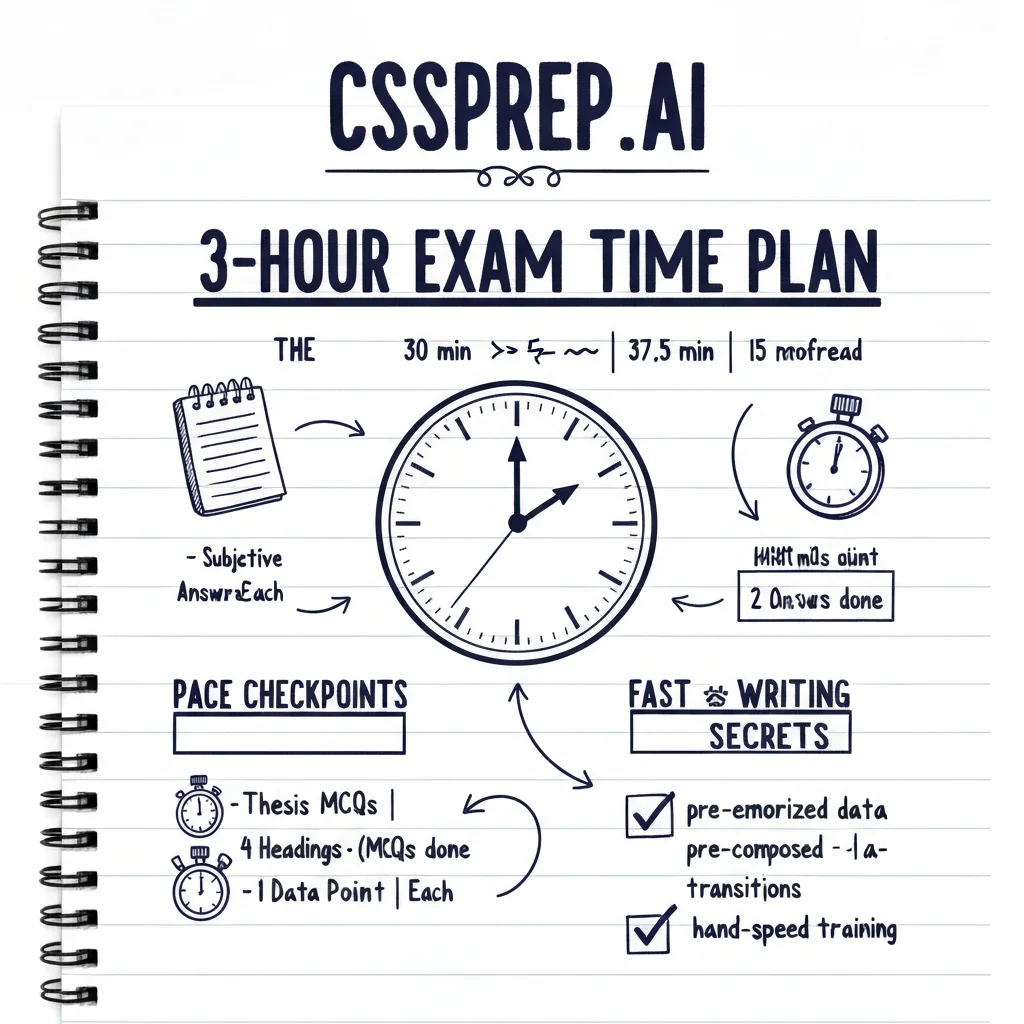
Let us do the cold hard math.
A standard CSS paper like Pakistan Affairs or Political Science is 3 hours or 180 minutes long.
- The first 30 minutes are strictly dedicated to the Objective Section the 20 MCQs.
- You are left with exactly 150 minutes to write four subjective answers worth 20 marks each.
If you divide 150 minutes by 4 questions you get exactly 37.5 minutes per question.
This is the golden number. If you spend 50 minutes writing a beautiful award-winning answer for your first question you have mathematically signed your own death warrant. You will inevitably only have 15 minutes left for your final question resulting in a panicked 2-page answer that scores a dismal 4 out of 20.
A consistent 12/20 on all four questions will always beat a 16/20 on one question and a 5/20 on the last. Balance is everything.
2. The 5-Minute Outline Strategy
Never start writing the moment you read the prompt.
Spend the first 5 minutes of your precious 37.5 allocation sketching a rapid rough outline on the last page of your answer booklet.
- Jot down your core thesis statement.
- List 4 to 5 main headings you will use.
- Under each heading scribble one piece of hard data or a relevant quote.
This 5-minute investment prevents you from rambling. When you write linearly without a plan you often realize halfway through page 3 that you forgot your main point. You then scratch out sentences ruining your presentation and wasting time.
If you struggle to brainstorm dimensions quickly under pressure rely on visual structures. During your preparation use our CSSPrep.AI Topic Explorer. Training your brain to visualize topics mechanically will allow you to generate a robust 5-point exam outline in under two minutes flat.
3. Mastering the Pace Check Points
You cannot stare at the wall clock constantly as it induces extreme anxiety. Instead establish physical checkpoints within your answer to gauge your speed.
A standard 20-mark answer should be approximately 6 to 7 pages long assuming average handwriting size.
- Minute 1 to 5 Brainstorming and outline.
- Minute 5 to 10 Writing the Introduction and Thesis statement.
- Minute 11 to 30 Blazing through the body paragraphs and headings. Look at your watch at the 20-minute mark. Are you on page 4? If yes you are perfectly on track. If you are only on page 2 you need to stop over-explaining your points and aggressively increase your writing speed.
- Minute 31 to 35 Writing the Conclusion.
- Minute 35 to 37.5 A rapid 2-minute proofread to fix glaring grammatical errors.
The moment the clock hits 37.5 minutes you must force yourself to stop writing even if you had one more brilliant point to make. Move to the next question immediately.
4. The Anatomy of Fast Writing
Writing fast is a physical and mental skill. You cannot suddenly write 25 pages in 3 hours on exam day if your hand is not conditioned to do it during your 10-month prep phase.
- The Pen Matters Do not use a brand new extremely sharp fountain pen that catches on the coarse exam paper. Use a reliable gel pen or a well-broken-in pointer that glides effortlessly. Your physical hand fatigue will dramatically decrease.
- Use the PEEL Format Stop writing massive blocks of text. Use the PEEL format Point Evidence Explanation Link. Write a clear heading. Write a 4-line paragraph making the point. Provide a bulleted list of 3 facts. Move on. The examiner loves bullet points and they are incredibly fast to write compared to dense paragraphs.
5. Simulating the Crucible
You must simulate the horror of the exam hall at home.
One month before the final exams select a randomized past paper. Set a timer for 150 minutes and attempt to write four 20-mark answers continuously without taking a single break. Your hand will cramp. Your brain will fog. This is completely normal but you must experience it in your bedroom before you experience it in the FPSC hall.
Furthermore writing fast often destroys sentence coherence. Submit your timed simulated answers to our CSSPrep.AI Essay Evaluator. The AI will instantly audit your work ensuring that your rapid writing did not compromise your grammatical accuracy or the logical flow of your thesis statement. Fast garbage still scores a zero. You must write fast and write well.
Useful Resources
- FPSC Official Website Download the official answer sheet specimen if available or simply practice on standard ruled register paper to accurately gauge exactly how many words you naturally fit on a single page.
- Bullet Journal The concept of rapid logging and utilizing bullet points effectively is a lifesaver in the CSS exam hall when you are running out of time.
The CSS exam is fundamentally an exercise in discipline. Control your time. Adhere rigidly to the 37.5-minute rule per question. Do not let one difficult question rob you of the time you need to answer the questions you actually know perfectly.