
Why Most CSS Essays Fail Before They Begin
Walk into any CSS marking room and examiners will tell you the same thing: the majority of scripts are penalized not for wrong facts, but for poor structure, weak argumentation, and a complete absence of analytical depth.
The CSS essay paper is 100 marks. To clear the aggregate, most candidates need at least 55–65 on this paper. Yet average scores hover around 40–45. That gap is not an intelligence gap — it is a technique gap.
This guide gives you the technique.
The 3-Part Architecture Every Scorer Uses
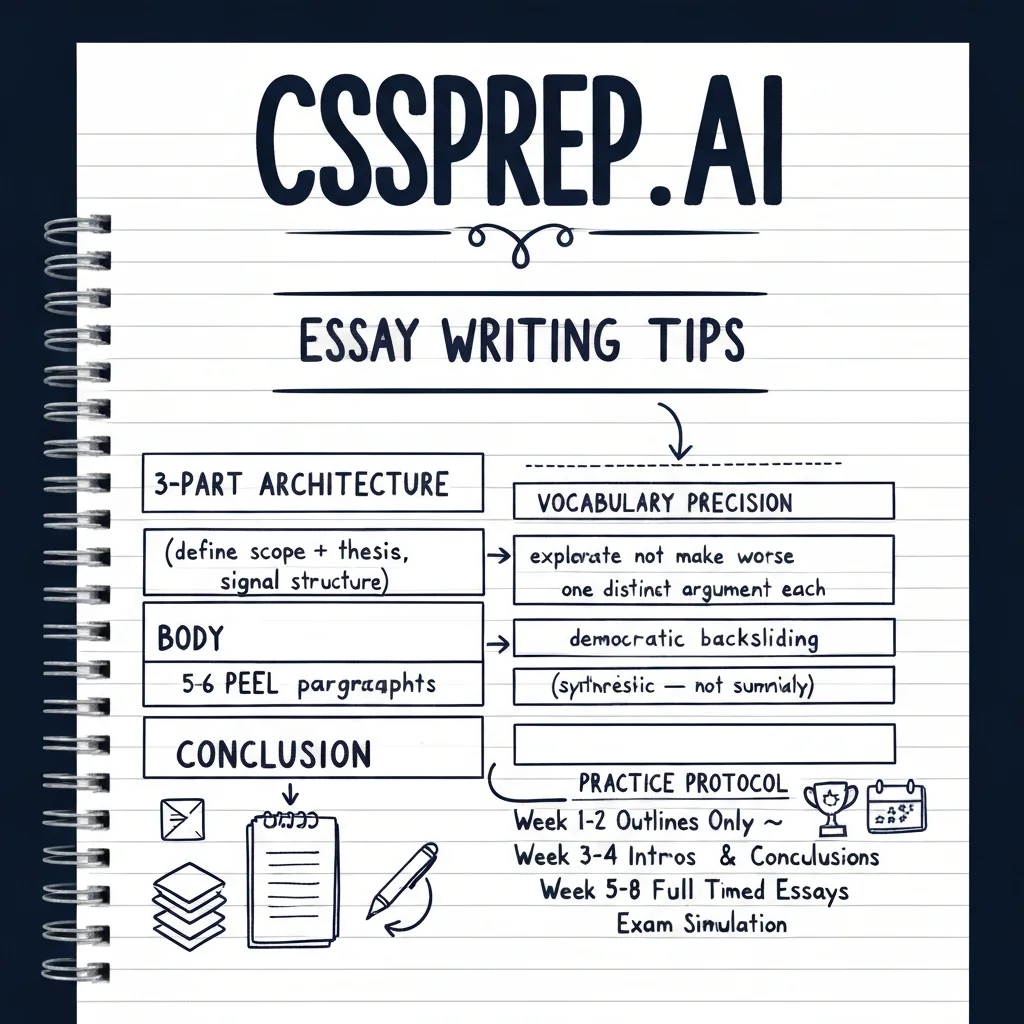
Top CSS essays follow a predictable skeleton. Examiners have seen thousands of scripts; they reward the ones that are easiest to mark. Make your essay scannable and logical.
1. The Introduction (10–12% of word count)
Your introduction must do three things in this order:
- Define the scope — frame what the essay will and won't cover
- State your thesis — take a clear, defensible position
- Signal your structure — one sentence previewing your main arguments
Weak: "Democracy is a system of government that has been widely discussed. Many scholars have different opinions about it."
Strong: "Pakistan's democratic experiments have repeatedly collapsed not from external pressure but from structural deficits within the democratic compact itself — weak institutions, clientelist politics, and a civil-military imbalance that systematically subordinates civilian authority. This essay argues that sustainable democracy in Pakistan requires simultaneous institutional reform across three domains: electoral integrity, judicial independence, and civil service depoliticization."
The strong version commits to a position. It tells the examiner what to expect. It uses precise vocabulary.
2. The Body (75–80% of word count)
Each body paragraph should follow the PEEL structure:
| Element | Purpose | Length |
|---|---|---|
| Point | Topic sentence stating the argument | 1–2 sentences |
| Evidence | Fact, statistic, historical example, or quote | 2–3 sentences |
| Explanation | How the evidence supports your point | 2–3 sentences |
| Link | Bridge to the next paragraph or the thesis | 1 sentence |
Aim for 5–6 PEEL paragraphs. Each one advances a distinct sub-argument.
Common mistake: Candidates write 8–10 short paragraphs that read like bullet points in prose disguise. Examiners want depth, not breadth.
3. The Conclusion (8–10% of word count)
Your conclusion is not a summary — it is a synthesis. The difference matters enormously.
Summary: "In conclusion, I discussed democracy, institutional reform, and civil-military relations."
Synthesis: "The evidence converges on a single insight: Pakistan's democratic deficit is ultimately a crisis of accountability. Until electoral incentives punish institutional sabotage rather than reward it, structural reforms will remain cosmetic. The path forward runs through citizens — an informed, organized electorate that refuses to trade long-term governance for short-term patronage."
A synthesis paragraph adds value. It tells the examiner something new emerged from your analysis.
The Vocabulary Trap
CSS markers are instructed to reward "sophisticated language use" — but many candidates misunderstand what this means.
It does not mean using the longest word available. It means:
- Precise diction: "exacerbated" instead of "made worse," "asymmetric" instead of "unequal"
- Hedged claims: "Evidence suggests…" not "This proves…"
- Register consistency: Stay academic throughout; avoid colloquialisms
Build a list of 50–60 domain-specific terms for each subject area. For governance essays: legitimacy deficit, democratic backsliding, rentier state, principal-agent problem. For economics: Dutch disease, balance of payments, import substitution industrialization.
Time Management on Exam Day
The CSS essay paper gives you 3 hours for one essay. Most candidates waste the first 30 minutes in panic.
The professional approach:
- 0–20 min: Brainstorm and outline. Write your thesis. Map 5–6 argument nodes.
- 20–140 min: Write. 120 minutes for roughly 1800–2200 words.
- 140–160 min: Proofread for logical gaps, not just typos.
- 160–180 min: Add any missed transitions or examples in margins (neat insertions are acceptable).
Do not start writing before you have a complete outline. Essays written without outlines meander and lose marks for coherence.
The Examiner's Checklist
Based on FPSC guidelines and interviews with CSS markers, here is what examiners actually look for:
- Relevance — Does every paragraph serve the central argument?
- Evidence density — Are claims backed by specific examples, not vague assertions?
- Analytical depth — Does the candidate explain why, not just what?
- Originality — Any insight the examiner hasn't seen 200 times this week?
- Linguistic precision — Technical vocabulary used correctly?
- Structural clarity — Can the argument be followed without re-reading?
Print this list. Review it after every practice essay.
Practice Protocol That Actually Works
Random practice does not build skill. Deliberate practice does.
Week 1–2: Write outlines only. 20 outlines for different essay prompts. Focus on thesis quality and argument architecture.
Week 3–4: Write introductions and conclusions. 15 complete intros and conclusions without writing the body.
Week 5–8: Write full essays. Time yourself. Score against the examiner checklist above.
Week 9–12: Simulate exam conditions. No notes, timed, handwritten. Review with the checklist.
The candidates who score 65+ have written 25–40 full practice essays before the exam. The candidates who score 40 have written 5–8.
Final Thought
The CSS essay is a skill, not a talent. Every element of a high-scoring essay can be learned, practiced, and systematized. The candidates who treat it as such — who study the technique with the same seriousness they study the content — are the ones who cross the cutoff.
Start with one essay. Outline it. Draft it. Score it honestly against the checklist. Iterate.