
Why Current Affairs Is the Most Misunderstood CSS Paper
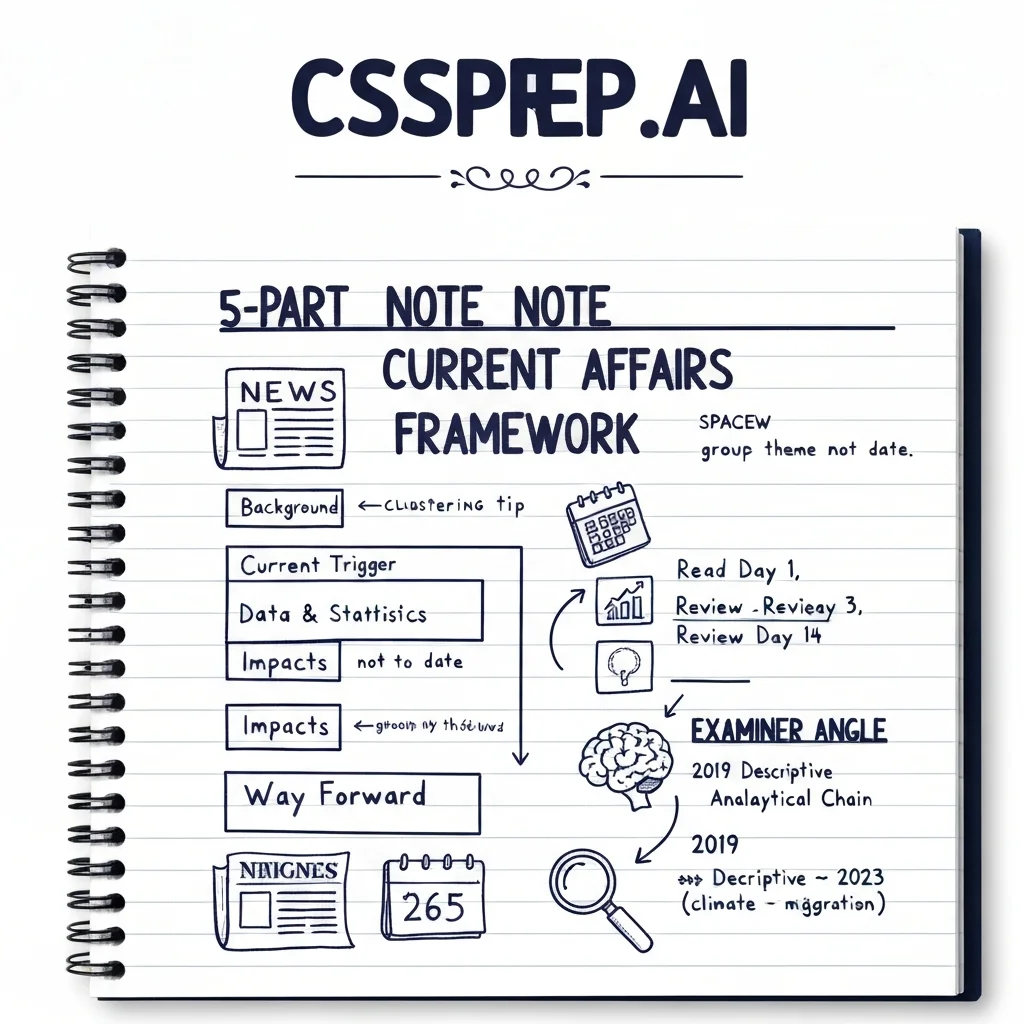
Ask ten CSS candidates how they prepare for Current Affairs and nine will say some version of "I read Dawn every day." This is necessary but nowhere near sufficient.
Daily newspaper reading without a systematic framework produces a vast, undifferentiated blob of information with no analytical structure. On exam day, candidates find themselves with plenty of facts but no way to organize them into coherent, mark-earning answers.
The 10% who score 70+ approach it completely differently. This is their framework.
The Four Dimensions of Every Current Affairs Topic
Any significant current affairs topic can be analyzed across four dimensions. Train yourself to build this framework automatically for each topic you study.
Dimension 1: Historical Context (Why this issue exists)
Every current affairs question is rooted in history. Examiners reward candidates who can situate contemporary events in their historical context.
Pakistan-IMF relations: Why is Pakistan in perpetual IMF programs? The answer requires understanding Pakistan's structural fiscal deficit, its tax-to-GDP ratio (historically 10–12% vs. the regional average of 15–18%), and the political economy of revenue reform.
Question to ask yourself: "How did we get here? What decisions made 10–20 years ago created this situation?"
Dimension 2: Current Dynamics (What is happening now)
This is where newspaper reading pays off. But specificity matters.
Weak: "Pakistan is facing economic challenges."
Strong: "Pakistan's current account deficit narrowed to $1.1 billion in the first half of FY2024–25, down from $3.5 billion in the same period the previous year, reflecting both import compression and a modest recovery in remittances — though the underlying structural vulnerabilities remain unaddressed."
Specificity signals genuine engagement with the topic. Collect precise data points, not just general trends.
Dimension 3: Competing Perspectives (What different stakeholders argue)
CSS examiners explicitly reward "balanced analysis." This means acknowledging that serious issues have multiple legitimate perspectives.
For any major policy debate, identify:
- The government's official position
- The opposition's critique
- Civil society / academic analysis
- International / multilateral institutions' view
- Regional neighbors' perspective (where relevant)
Example — Climate Policy:
- Government: NCCP commitments, growing renewable sector
- Critics: Gap between commitments and implementation
- Academics: Vulnerability-responsibility asymmetry (Pakistan contributes < 1% of global emissions but faces disproportionate impacts)
- World Bank / ADB: Financing gap analysis
A paragraph covering all four perspectives earns significantly more marks than a paragraph covering one.
Dimension 4: Future Trajectory (Where this is heading)
Examiners want to see you think beyond the immediate situation.
Questions to practice: "What are the likely outcomes if current trends continue?" "What would constitute a positive vs. negative resolution?" "What are the critical decision points coming in the next 12–24 months?"
Candidates who demonstrate forward-looking analysis signal intellectual maturity. This is rare and rewarded.
Building Your Topic Bank
Current Affairs is approximately 12 major topic areas, each with 3–5 sub-topics. Map them systematically.
Core Topic Areas for 2025
| Area | Key Sub-Topics |
|---|---|
| Pakistan Economy | IMF program, inflation trajectory, fiscal reform, SIFC |
| Foreign Policy | SCO chairmanship, Afghanistan, India relations, US-China dynamics |
| Regional Security | Afghan Taliban, TTP, FATF, border management |
| Climate & Environment | Floods / disasters, NDCs, loss and damage |
| Governance | Judicial independence, electoral reform, civil service |
| Technology | Digital Pakistan, cybersecurity, AI policy |
| Social Issues | Education emergency, healthcare gaps, urbanization |
| Energy | Circular debt, renewable transition, power sector reform |
| Agriculture | Food security, water stress, crop modernization |
| Human Rights | Women's rights, minorities, press freedom |
| International Organizations | UN reform, WTO, IMF / World Bank dynamics |
| Geopolitics | CPEC, BRI, multilateralism vs. great power competition |
For each sub-topic, build a one-page "brief" using the four-dimension framework.
The Dawn Reading Protocol
Yes, you should read Dawn. But read it strategically.
Daily (15–20 minutes):
- Front page: What happened today?
- Op-eds: What analytical frameworks are serious commentators using?
- Scan, don't absorb — not the full paper
Weekly (45–60 minutes):
- Identify the 3–5 most exam-relevant stories of the week
- For each, update your topic briefs
- Note any new data points or perspectives
Monthly (2 hours):
- Review all topic briefs
- Identify gaps
- Practice writing one complete answer per topic area from memory
The Answer Structure for Current Affairs Questions
Most Current Affairs questions are 15–20 marks and expect 400–600 words. The structure that consistently scores well:
Introduction (50–75 words): Define the topic and state its significance. One sentence of context, one sentence of scope.
Body (300–400 words): 3–4 paragraphs, each covering a distinct dimension. Use the four-dimension framework: historical context, current dynamics, competing perspectives, and trajectory.
Conclusion (75–100 words): Synthesize the key tension or insight. What is the fundamental challenge? What would resolution require?
Time allocation: 15 minutes for a 15-mark question. 20 minutes for a 20-mark question. Stick to this rigorously.
The Multi-Source Rule
One source is not enough. Top scorers use a minimum of three:
- Dawn — primary source for Pakistan domestic developments
- The News / Express Tribune — different editorial perspectives
- One international source (BBC, Al Jazeera, or The Economist) — for global context and comparative framing
The international source is what most candidates skip. Adding comparative international examples to Pakistan-focused answers immediately signals a more sophisticated analytical perspective.
Common Mistakes That Kill Current Affairs Scores
1. Recency bias — Preparing only the last 6 months. CSS questions often require understanding developments over 2–3 years.
2. Opinion without evidence — "Pakistan's foreign policy has failed" without specific examples, missed opportunities, or comparative benchmarks.
3. Incomplete coverage — Answering the question partially. If a question has three parts, address all three. Partial answers get partial marks.
4. Over-reliance on CPEC / economy — Candidates prepare these topics deeply and neglect others. Questions on education, climate, or technology catch them underprepared.
5. Ignoring regional context — Pakistan's challenges are rarely unique. Comparative regional analysis (South Asia, Middle East, China) adds marks examiners specifically reward.
The Practice Regime
Weeks 1–4: Build your topic bank. 12 topic briefs, detailed.
Weeks 5–8: Practice writing answers. 20 complete answers across different topics, timed at 15 minutes each.
Weeks 9–12: Mock exams. Full paper simulations, marking your own answers against the four-pillar marking rubric.
Running throughout: Daily Dawn protocol. Weekly topic brief updates.
Candidates who follow this regime and do the practice consistently emerge from Current Affairs with 65–75 marks. Those who just "follow the news" without the framework rarely break 55.
The Bottom Line
Current Affairs mastery is a system problem. The candidates who score 70+ are not more intelligent or better informed — they are more organized. They have a framework, they apply it consistently, and they practice under exam conditions.
Build the framework. Apply it to every topic. Practice under time pressure. The marks follow.