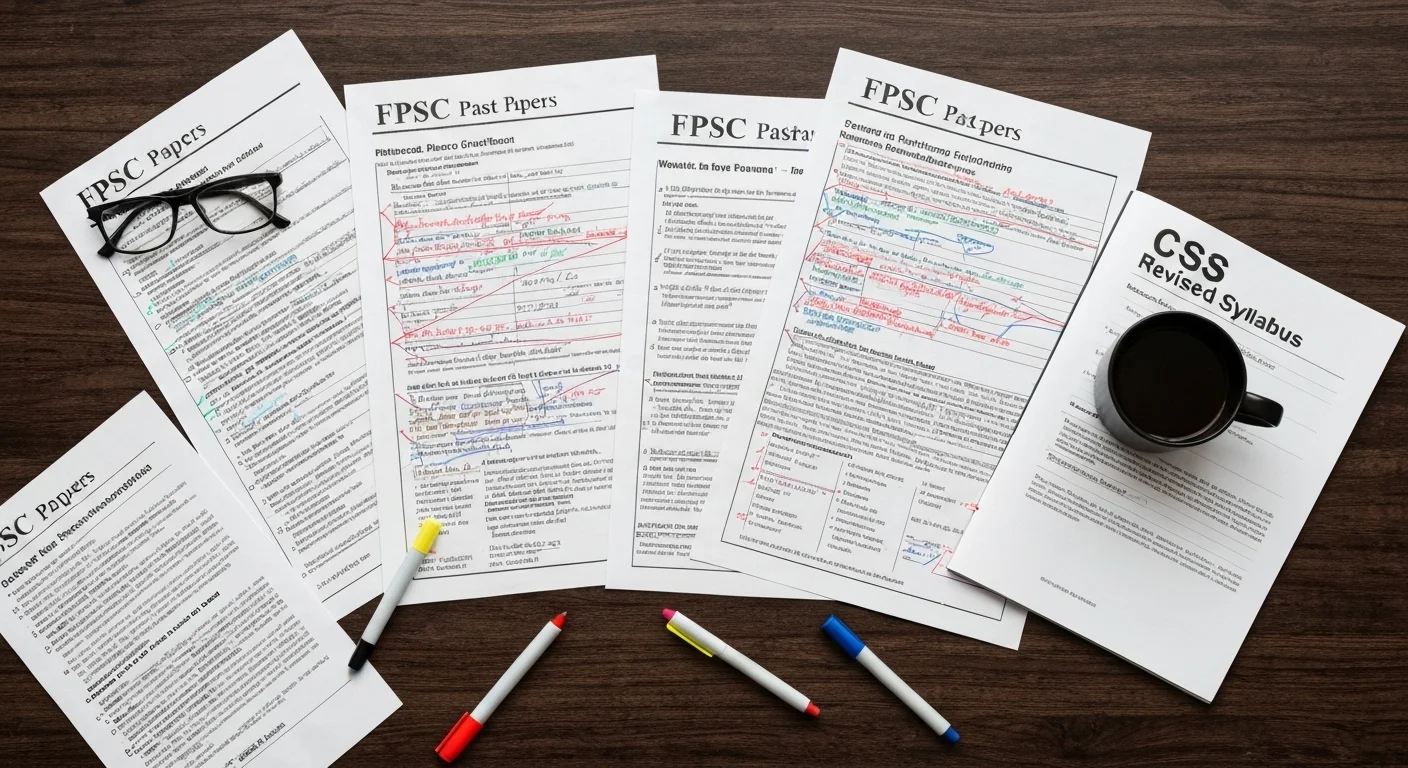
Why CSS Past Papers Analysis is Your Ultimate Cheat Code
If you were handed a detailed map showing exactly where the enemy would attack in a war you would not throw it away and blindly charge into battle.
Yet this is exactly what thousands of CSS candidates do every year. They spend ten months reading massive textbooks memorizing obscure facts and exhausting themselves without ever once looking at the FPSC past papers. When they finally enter the exam hall they are immediately ambushed by the way the examiner actually frames the questions.
The FPSC syllabus tells you what topics exist. But a deep CSS past papers analysis tells you exactly how those topics will be tested. Past papers are not just practice material. They are the ultimate cheat code to narrowing down your syllabus predicting exam trends and guaranteeing your success.
Here is exactly how you should dissect analyze and utilize past papers to dominate your CSS preparation.
1. The 5-Year Reverse Audit Strategy
Do not look at past papers from 1998. The geo-political realities the examiner's mindset and the syllabus itself have changed drastically. The golden rule is to rely exclusively on the last 5 to 7 years of past papers.
Before you read a single chapter of a new subject perform a Reverse Audit.
- Print out the last 5 years of past papers for that subject (e.g., Pakistan Affairs from 2018 to 2023).
- Take a set of highlighters and map every single question back to its specific heading in the FPSC syllabus document.
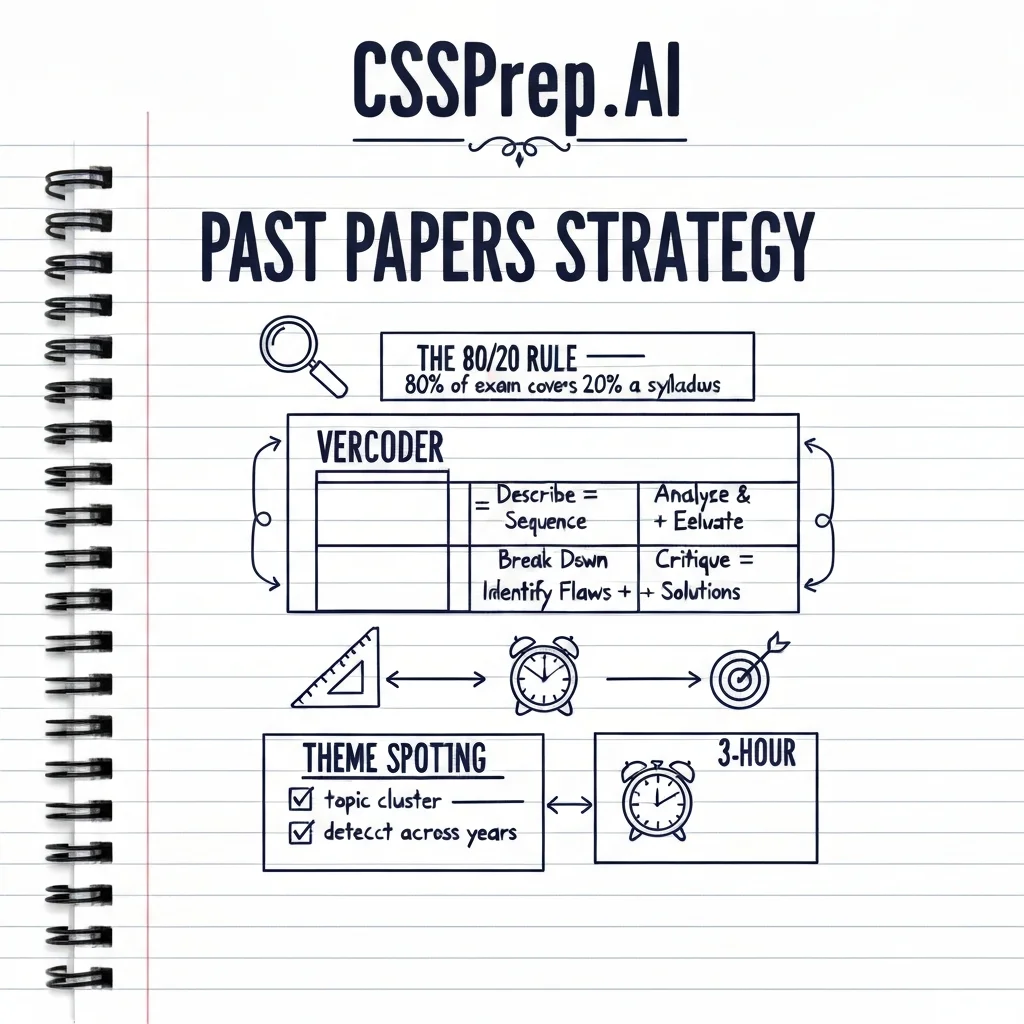
- You will immediately notice a shocking pattern. Out of 20 dense chapters in the syllabus 80% of the exam questions are repeatedly pulled from the exact same 5 or 6 core chapters.
This CSS past papers analysis instantly saves you months of wasted time. You now know exactly which chapters require 100% of your energy and which chapters you can merely skim.
2. Decoding the Examiner's Verb
Candidates often fail because they answer the question they wanted to see rather than the question the examiner actually asked.
When analyzing past papers pay microscopic attention to the primary verb used in the prompt.
- "Describe" or "Outline" The examiner wants a factual sequential explanation of an event. (e.g., Outline the events leading to the 1971 war.)
- "Analyze" or "Critique" The examiner expects you to break the event down evaluate its successes and failures and provide a balanced judgment. (e.g., Critique the economic policies of the 1990s.)
- "Compare and Contrast" You must draw explicit parallels and differences between two core concepts.
If a past paper asks you to "Critique" an economic policy and you merely "Describe" it by writing a historical summary you will fail even if every fact you wrote was historically accurate.
3. The Power of Theme Spotting
History does not repeat itself but it rhymes.
Through dedicated CSS past papers analysis you will realize that the FPSC loves repeating specific themes constantly especially in subjects like Islamic Studies and Current Affairs.
- In Islamiat questions regarding the application of the Islamic Economic System vs Capitalism or the status of women in Islam appear almost every alternative year.
- By spotting these overarching themes you can prepare "Master Notes". A master note is a highly refined 2-page document packed with exact Quranic references data and analytical arguments that you can twist to answer slightly different questions on the same theme.
If a theme is sprawling and complex like the "Afghan Peace Process" use our CSSPrep.AI Topic Explorer. Create a central node for the theme and branch out to record how the FPSC asked about it in 2019 versus how they asked about it in 2022. Visualizing these themes solidifies your understanding of the examiner's shifting focus.
4. The 3-Hour Simulation Rule
Reading past papers is only the diagnostic phase. The execution phase requires brutal simulation.
Two months before your final exam you must use past papers to simulate real exam conditions.
- Lock your door. Remove your phone. Set a strict 3-hour timer.
- Select a random past paper from 3 years ago and attempt to write 4 complete 20-mark answers.
- This simulation forces you to confront the physical reality of the CSS exam. Does your hand cramp after hour two? Did you spend 55 minutes on the first question leaving only 30 minutes for the final question?
5. Get Your Simulations Evaluated
A simulation is only valuable if you analyze the results. Writing four brilliant answers is pointless if your paragraph structure is flawed or your thesis is weak.
This is where you must leverage technology. Take the answers you generated during your past paper simulation and run them through our CSSPrep.AI Essay Evaluator. Our tool is calibrated to the strict analytical demands of the FPSC. It will instantly tell you if your introduction was too broad if your arguments lacked hard evidence or if your grammatical structure collapsed under the 3-hour time pressure. Instant feedback is the only way to rapidly improve.
Useful Resources
- FPSC Official Website This is the only place you should be downloading your past papers from. Relying on third-party websites often results in downloading corrupted localized or fake papers. Always use the official FPSC archives.
- Harvard Business Review Reading Harvard Business Review articles trains your brain to break down complex institutional problems systematically which is exactly the analytical tone required to answer past paper critical questions.
Stop reading aimlessly. Let the past papers dictate your study schedule. Master the examiner's language identify the recurring themes and attack the syllabus with surgical precision.