1. The Essay Paper Bottleneck: Why 40 Marks is the Holy Grail
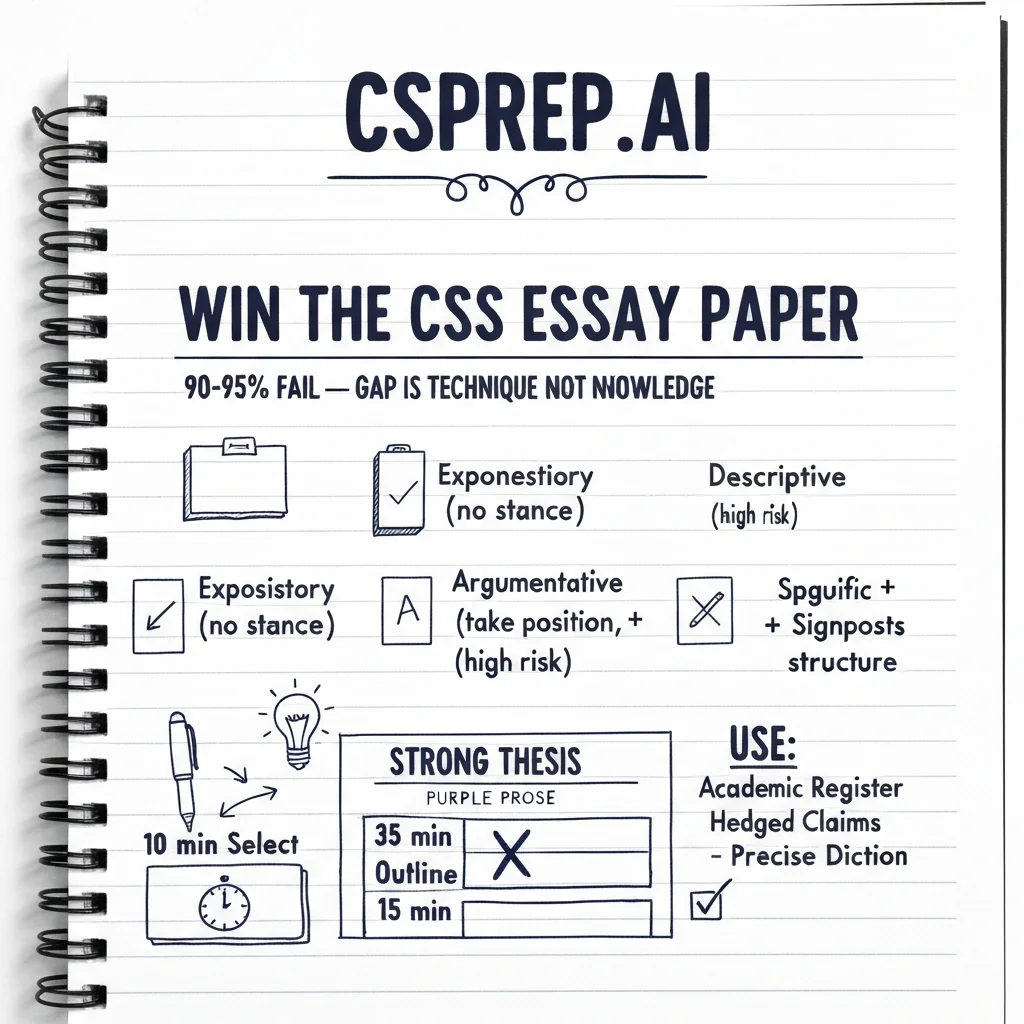
In the pantheon of FPSC CSS subjects, the English Essay occupies a terrifying, almost mythological status. Statistically, it is the single greatest executioner of CSS aspirations. Year after year, the examiner reports reveal a grim reality: nearly 90% to 95% of candidates fail this specific paper.
To pass the English Essay paper, a candidate must secure a minimum of 40 marks out of 100. While 40% might sound like a low bar in traditional academic settings, the FPSC's marking criteria are notoriously stringent. Examiners are not looking for a mere collection of facts or flowery language; they are ruthlessly hunting for logical coherence, structural integrity, and analytical depth.
Failing to hit that 40-mark threshold means a candidate fails the entire CSS examination, regardless of whether they scored 80s in their optional subjects. Consequently, your preparation for CSS 2027 cannot merely be about "improving your English"; it must be a fundamentally structural endeavor aimed at systematically securing those 40 marks through bulletproof argumentation. This 2,000-word guide breaks down the exact architectural framework required to not only pass the essay but to confidently push into the high 50s and 60s.
2. Decoding FPSC Essay Topics: Argumentative vs. Expository
Before you write a single word, you must understand what you are being asked to write. FPSC essay topics generally fall into three broad categories, and misidentifying a prompt is the fastest way to score a zero.
Expository Essays
These prompts require you to explain, define, or inform the reader about a specific issue without necessarily taking a definitive, polarizing stance. Example: "The socio-economic impacts of the climate crisis in South Asia." Here, the examiner wants a comprehensive mapping of the issue: health impacts, agricultural depression, and displacement.
Argumentative Essays
These prompts demand that you take a firm, unambiguous position on a contestable issue and defend it using logic and evidence while refuting counterarguments. Example: "Is democracy failing to deliver in developing nations?" You cannot sit on the fence here. You must choose "Yes," "No," or a nuanced "Only under specific structural conditions," and build a case.
Descriptive / Literary Essays
These are abstract, quote-based prompts (e.g., "The boy is the father of the man"). While tempting for candidates with a literature background, these are high-risk. Examiners often complain that candidates meander without a clear thesis in literary essays. Unless you are exceptionally gifted at abstract synthesis, it is statistically safer to stick to objectively verifiable socio-political or economic topics.
3. The Architecture of a Winning Essay: Thesis and PEEL
An essay that scores above 40 marks is not a stream of consciousness; it is a meticulously engineered structure.
The Thesis Statement: Your Essay's Spine
The thesis statement is the single most important sentence you will write in your 3-hour exam. Placed at the very end of your introductory paragraph, it is a concise, debatable summary of your entire argument. Weak Thesis: "Climate change is a big problem for Pakistan's economy and we must fix it." (Too broad, obvious). Strong Thesis: "While Pakistan contributes minimally to global carbon emissions, its structural agricultural dependencies and lack of climate-resilient infrastructure make it disproportionately vulnerable to climate change, necessitating an urgent shift toward decentralized, green economic policies." (Specific, argumentative, outlines the essay's trajectory).
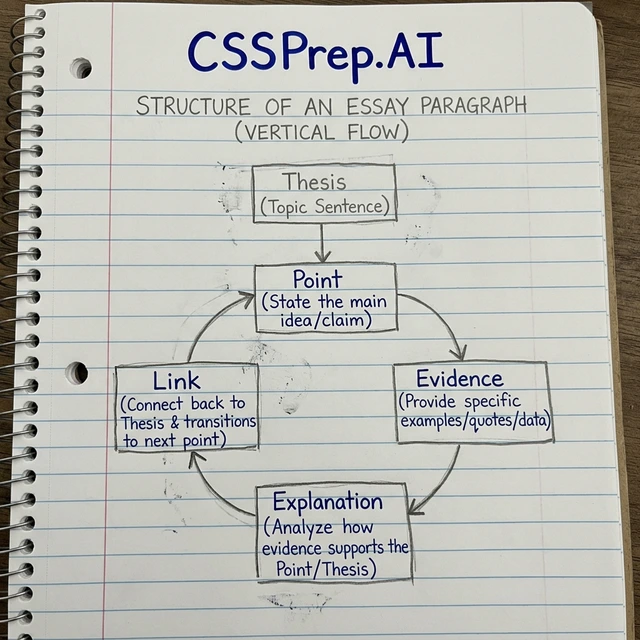
The PEEL Paragraph Structure
Every single body paragraph you write must follow the PEEL framework. If you memorize one concept from this guide, let it be this.
- Point (Topic Sentence): The first sentence of the paragraph states the main argument of that specific paragraph. It must directly connect back to your thesis statement.
- Evidence: The subsequent 2-3 sentences provide verifiable data, historical precedents, or expert quotes to substantiate your Point. (e.g., "According to the World Bank, the 2022 super-floods caused economic damages exceeding $30 billion...").
- Explanation (Analysis): The most critical part. Your evidence does not speak for itself. You must explain how and why this evidence proves your Point. This is where analysis happens and where examiners award marks.
- Link: The final sentence smoothly transitions to the next paragraph or links the paragraph's conclusion back to the central thesis.
If every body paragraph strictly adheres to PEEL, you mechanically eliminate the "structural collapse" that examiners cite as the primary reason for failing candidates.
4. Vocabulary, Expression, and Coherence: The "Purple Prose" Trap
A pervasive myth in the CSS ecosystem is that you need an esoteric, Shakespearean vocabulary to impress the examiner. This is fundamentally false and actively harmful.
Academic Register vs. Purple Prose
FPSC examiners are looking for an "academic register"—which means your writing should be formal, precise, and objective. They explicitly penalize "purple prose," which is overly ornate, melodramatic, and unnecessarily complex language that obscures meaning.
Purple Prose (Penalized): "The pernicious ramifications of the aforementioned climatic cataclysm have fundamentally eviscerated the agrarian foundations of our beloved motherland." Academic Register (Rewarded): "The severe climatic disruptions have significantly undermined Pakistan's agricultural sector, threatening national food security."
Coherence and Transitions
To secure those 40 marks, your essay must read like a single, cohesive thought piece, not 25 isolated paragraphs stapled together. You achieve coherence through the mastery of transition words.
- To add information: Furthermore, moreover, additionally.
- To contrast: Conversely, nevertheless, notwithstanding.
- To show cause/effect: Consequently, thereby, thus.
Transitions act as the logical connective tissue of your essay, guiding the examiner effortlessly from your introduction to your conclusion.
5. Time Management on Exam Day
You have 180 minutes to write a 2,500-3,000 word comprehensive essay. Time management is not a suggestion; it is the boundary between passing and failing. A beautiful essay that is left without a conclusion will fail.
The 180-Minute Blueprint
- Topic Selection (10 Minutes): Read all 10 topics. Discard the ones you don't instantly understand. Narrow it down to two. Brainstorm lightly on both. Pick the one where you can formulate the strongest, most nuanced thesis statement.
- Brainstorming and Outlining (35 Minutes): Do not start writing prose yet. Spend over half an hour physically drawing out your essay's structure on the rough pages. Write down your thesis. List your 15-20 PEEL paragraph topics. Outline your counter-arguments. Once this skeleton is built, the actual writing becomes merely "filling in the blanks."
- Drafting (120 Minutes): Write relentlessly. Stick strictly to your outline. If you have a brilliant new idea midway through, ignore it unless you have time to restructure your entire thesis. Consistency is more important than sudden inspiration.
- Review and Proofread (15 Minutes): This is non-negotiable. Save 15 minutes to review your work. You will find subject-verb agreement errors, spelling mistakes, and missing transition words that occurred purely due to adrenaline. Fixing these errors can literally be the difference between a 38 (Fail) and a 40 (Pass).
6. Instant Structural Feedback with CSSPREP.AI
You cannot master the PEEL structure by simply reading about it. You must write, and critically, you must be evaluated. In the past, self-correction was incredibly difficult. Today, AI has democratized elite exam preparation.
Using the CSSPREP.AI Writer and Evaluator
To guarantee you hit the 40-mark threshold in CSS 2027, you should build a habit of writing one essay every weekend and immediately running it through our tools.
The CSSPREP.AI Writer can help you ideate outlines and generate high-level vocabulary suggestions tailored to specific socio-political themes.
More importantly, the CSS Evaluator acts as a digital FPSC examiner. When you submit your practice essay, the AI specifically scans for structural compliance. It will highlight paragraphs that lack evidence, flag topic sentences that drift from the thesis, and warn you if your language leans into "purple prose." Getting this granular structural feedback in seconds, rather than weeks, accelerates your learning curve exponentially.
Mastering the CSS English Essay is not about unearthing obscure facts; it is about mastering the mechanics of logic. Internalize the PEEL structure, write precisely, manage your time ruthlessly, and leverage AI to iterate rapidly. That is how you secure your 40 marks and ensure your name on the final allocation list.